


What Does Insure Domestic Tranquility Mean? A Complete Guide
If you have searched what does insure domestic tranquility mean, you probably want more than the usual answer, “keep peace in the country.” That short definition is correct, but it leaves out the most useful parts: why the Framers chose these words, what kind of peace they meant, which parts of the Constitution support that goal, and where the government’s authority stops.
In plain English, “insure domestic Tranquility” means to help secure peace, public order, and political stability within the nation. It does not mean making every person agree, ending every protest, or promising that no crime will ever happen. It means creating a constitutional system in which disputes can be handled through laws, courts, elections, and peaceful civic action instead of violence, rebellion, or conflict between states.
The easiest way I remember the phrase is this: “domestic” points inward, while “common defence” points outward. Domestic tranquility concerns peace inside the country. Common defense concerns protection from threats coming from outside it.
Quick answer: what does insure domestic tranquility mean?
The phrase appears in the Preamble to the Constitution. It identifies internal peace and stability as one reason the people created the new constitutional government. In this context, “insure” means secure or make reasonably certain, “domestic” means within one’s own country, and “tranquility” means public peace and calm.
A strong one-sentence answer is: To insure domestic tranquility means to create and maintain peaceful order within the nation so that people and states can resolve conflicts through lawful institutions rather than violence. This answer is more accurate than simply saying “keep everyone quiet,” because constitutional peace allows disagreement, criticism, protest, and change.
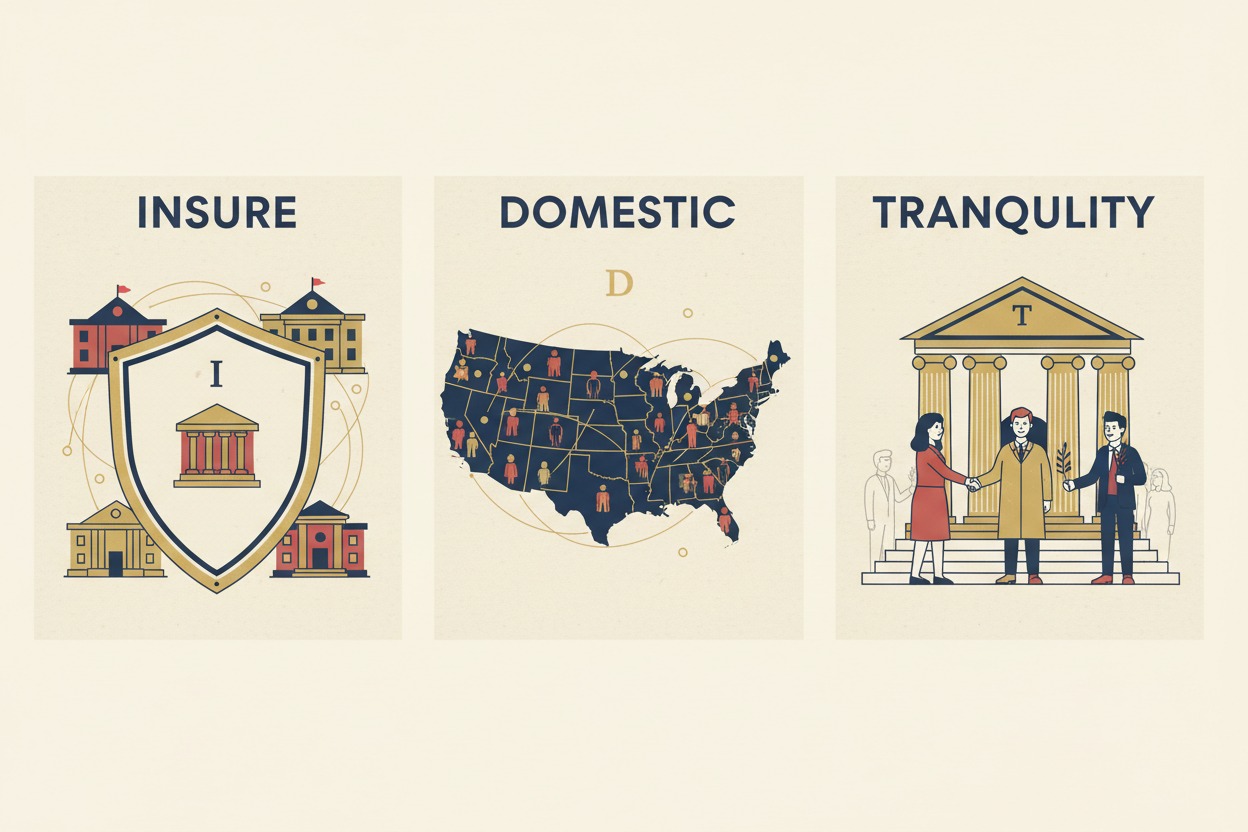
Here is the phrase broken into its three parts. Each part corrects a different common misunderstanding:
| Word | Meaning in this phrase | What it does not mean |
|---|---|---|
| Insure | Secure, safeguard, or make reasonably certain | Buy an insurance policy |
| Domestic | Inside the nation or among its states and people | Only inside a private home |
| Tranquility | Public peace, order, and freedom from violent internal conflict | Silence, forced agreement, or no debate |
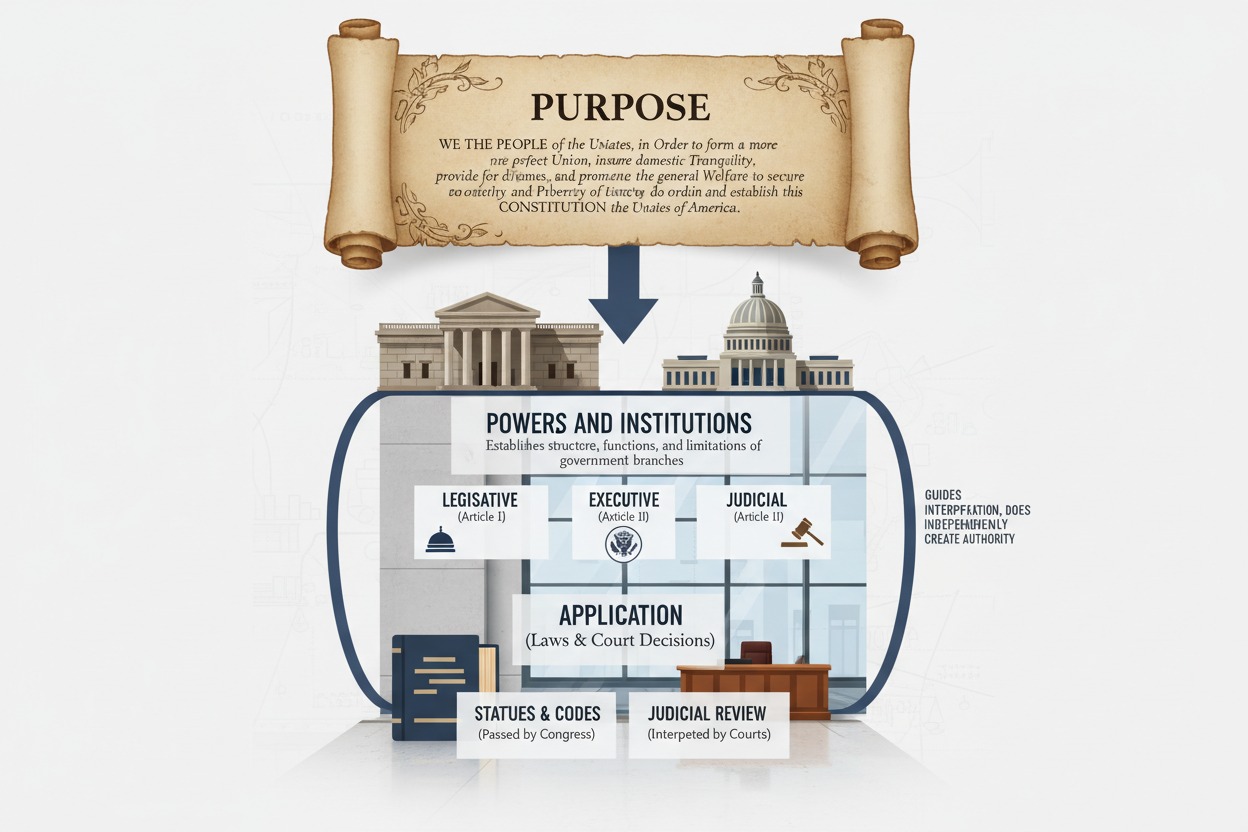
The phrase is a purpose stated in the Preamble, not a stand-alone law. The federal courts’ explanation of the Preamble makes this distinction clear: the Preamble introduces the Constitution and communicates its purposes, but it does not itself define government powers or individual rights.
Where does “insure domestic Tranquility” appear?
The words appear in the Constitution’s opening sentence, known as the Preamble. The official transcription of the Constitution states that “We the People” established the Constitution to pursue six broad purposes, including forming a more perfect union, establishing justice, and insuring domestic tranquility.
The phrase sits between “establish Justice” and “provide for the common defence.” Its position is useful because it shows a logical sequence. Fair institutions help people settle disputes, internal peace lets those institutions operate, and common defense protects the political community from external danger.
The six purposes in the Preamble
The Preamble does not present six separate departments or six laws. It presents six connected goals that explain why the constitutional system was created.
| Preamble purpose | Plain-English meaning |
| Form a more perfect Union | Build a stronger and more workable union than the earlier confederation |
| Establish Justice | Create fair laws, courts, and legal processes |
| Insure domestic Tranquility | Secure peace and order within the nation |
| Provide for the common defence | Protect the whole nation from external threats |
| Promote the general Welfare | Support conditions that benefit the public as a whole |
| Secure the Blessings of Liberty | Protect freedom for the present generation and future generations |
These goals should be read together. Order without liberty can become repression, while liberty without law can become insecurity. The Preamble’s design is therefore broader than a simple promise to stop unrest.
Does the Preamble create legal power?
No, not by itself. A public official cannot claim a new power merely by pointing to the words “insure domestic Tranquility,” and an individual generally cannot base a lawsuit on that phrase alone. Government action still needs authority from an operative part of the Constitution or from a valid law passed under it.
This limit is important because some explanations accidentally turn an aspiration into an unlimited power. The phrase helps explain the Constitution’s purpose, but the detailed articles supply the institutions and powers. That is also why understanding the Constitution’s status as the supreme law of the land is helpful: constitutional authority depends on the document’s actual provisions, not just its opening statement.
The Preamble still matters as context. The historical account in the Constitution Annotated explains that founding-era preambles commonly stated a document’s objects and historical reasons. They could guide understanding without replacing the specific rules that followed.
What each word meant when the Constitution was written
Modern readers often stumble over the phrase because all three words can send the mind in the wrong direction. “Insure” now sounds financial, “domestic” can suggest household matters, and “tranquility” can sound like total silence. Founding-era usage gives the phrase a much clearer meaning.
Why does the Constitution say “insure” instead of “ensure”?
The Constitution is not referring to an insurance company or a financial policy. In eighteenth-century usage, “insure” could carry the general sense of securing something or making it certain. The spellings and meanings of “insure” and “ensure” overlapped more than they usually do in present-day edited English.
A detailed 2025 legal study of the phrase examined early dictionaries and hundreds of historical uses. That original-public-meaning research on domestic tranquility concludes that “insure” is being used in its broader sense of securing something, not in the narrower commercial sense of reimbursing a loss.
If the Preamble were drafted today, many editors would probably choose “ensure domestic tranquility.” We should not silently change the historical quotation, however. The original wording is “insure,” and its intended sense is closer to secure, safeguard, or make reasonably certain.
Does “domestic” mean inside the home?
Not here. “Domestic” could refer to a family or household, but by the eighteenth century it also referred to one’s own country, especially when contrasted with foreign affairs. The context settles which meaning applies in the Preamble.
The next goal is to provide for the common defense, which is mainly outward-facing. Domestic tranquility is its inward-facing partner. It concerns peace within the political community, including peace among states, institutions, groups, and citizens.
This distinction also prevents a serious modern misunderstanding. The Preamble is not a constitutional rule about marriage, family arguments, or domestic abuse. Those are important legal and social issues, but they are not what this particular phrase means.
What kind of “tranquility” did the Framers mean?
“Tranquility” meant peace, calm, stillness, or freedom from disturbance. When applied to a society, it referred to public peace and political order rather than an individual’s private feeling of relaxation. Founding-era sources also associated public tranquility with secure rights, orderly government, and laws that could actually operate.
The word does not promise perfect calm. No free society can eliminate every crime, argument, strike, election dispute, or public demonstration. A more practical reading is that the constitutional system should reduce the danger that ordinary conflicts turn into sustained violence, insurrection, or breakdown between governments.

Why domestic tranquility mattered in 1787
The phrase came from a period when the new nation had won independence but had not yet built a strong, workable national government. Under the Articles of Confederation, the states remained highly independent, while the central Congress lacked several powers needed to respond to shared problems. Peace had been achieved with Britain, but political and economic stability at home was far from guaranteed.
The National Archives’ account of the Articles of Confederation notes that Congress could not tax, had weak commercial authority, struggled to support a war effort, and had little power to settle quarrels among states. Debt, trade restrictions, paper money, border disputes, and war-related financial pressures created a tense environment. The challenge was not simply street crime; it was whether a union of states could remain functional.
Shays’ Rebellion and the lesson of weak national power
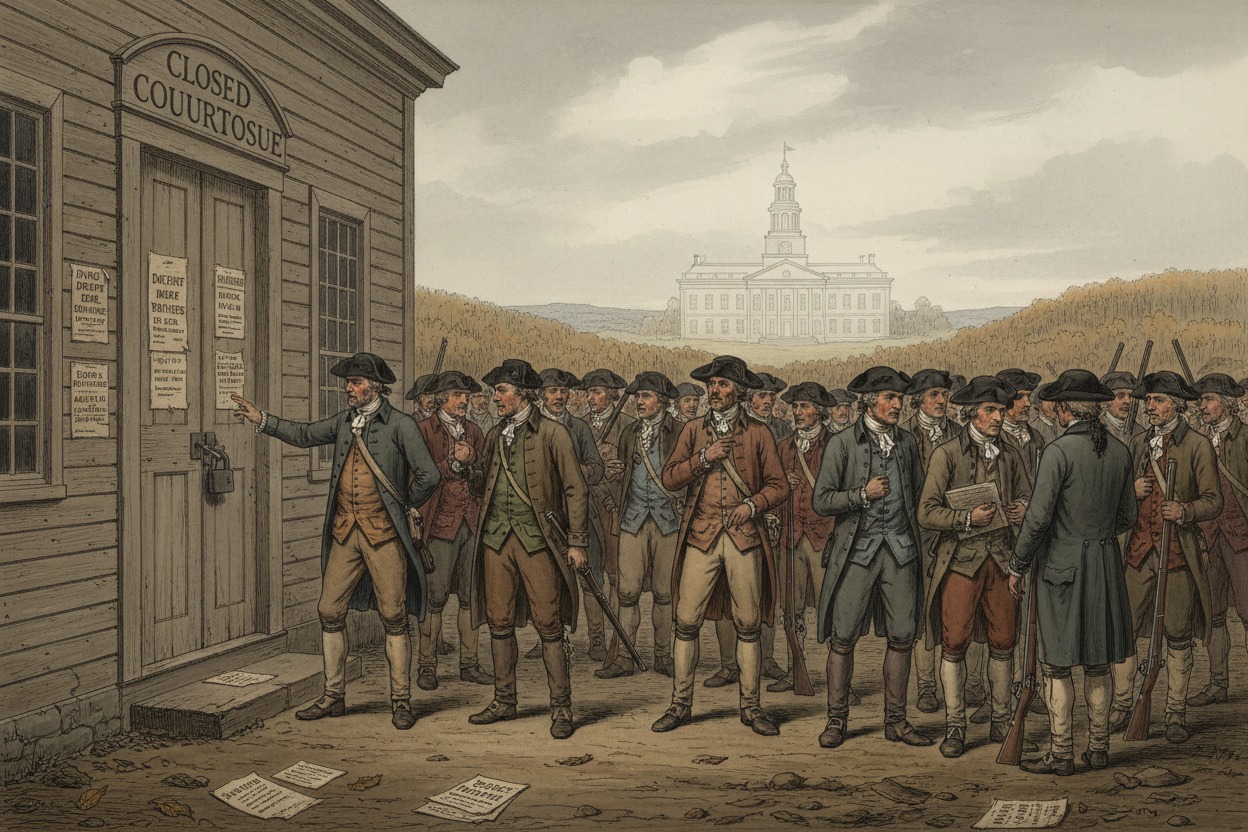
Shays’ Rebellion is the event most often connected with domestic tranquility. Beginning in 1786, farmers and other debt-burdened residents in Massachusetts protested tax and court policies. Groups shut down courts, and armed participants later tried to seize the federal arsenal at Springfield.
The Confederation Congress lacked the resources to provide an effective national response. The rebellion was ultimately defeated by state forces and a privately financed militia. The event ended only a few months before the Constitutional Convention began in May 1787, so it became a vivid warning about institutional weakness.
The National Archives’ history of the Constitution places the rebellion within a larger picture of economic distress, interstate friction, and fear that the political system could collapse. This broader context matters. Shays’ Rebellion did not single-handedly write the Preamble, but it showed what could happen when public grievances, financial pressure, and weak government met without an effective national framework.
A careful historical correction
Many short articles state that the Framers inserted the exact phrase solely because of Shays’ Rebellion. That claim is too confident. The Convention record does not preserve a debate explaining why each final phrase was chosen, and the wording was developed through the Committee of Style, commonly associated with Gouverneur Morris.
The safer conclusion is based on timing, context, and founding-era usage. Internal rebellions, quarrels among states, political faction, and the recent Massachusetts crisis made public tranquility an urgent concern. Shays’ Rebellion is strong evidence of that concern, but it should be described as a major example rather than the one proven cause of the clause.
What the historical story teaches
The history reveals three layers that a one-line definition misses. Together, they show why institutions matter as much as emergency force:
- Domestic tranquility was national, not merely local. The new system needed a way to address disputes that individual states could not manage alone.
- Economic and legal grievances could become security problems. Courts, taxation, property, representation, and public order were connected.
- Peace required capable institutions, not force alone. A government needed revenue, lawful authority, courts, and coordination as well as the ability to respond to violence.
This final point is the most useful one for modern readers. The Constitution’s answer to disorder was not simply a stronger executive or a larger armed force. It was an entire structure of separated powers, federalism, courts, representation, and enforceable law.
How the Constitution helps insure domestic tranquility
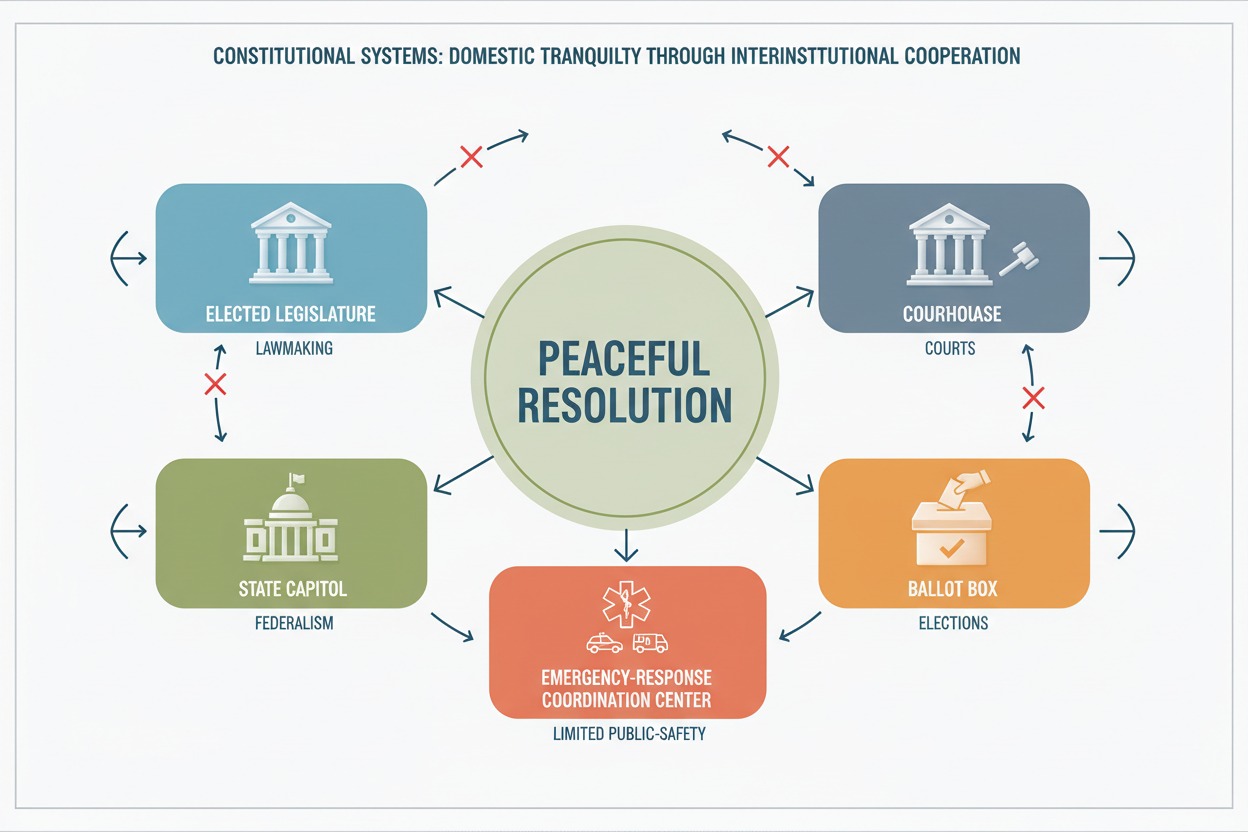
The Preamble states the goal, while later provisions create mechanisms that can support it. No single clause does all the work. Internal peace comes from a combination of representative government, enforceable laws, peaceful dispute resolution, cooperation between governments, and carefully limited emergency powers.
Congress can provide for enforcing law and suppressing insurrection
Article I, Section 8 gives Congress power to provide for calling forth the militia to execute federal law, suppress insurrections, and repel invasions. The Constitution Annotated explanation of the militia power shows a direct textual connection between constitutional authority and the problem of serious internal disorder.
This provision is narrower and more concrete than the Preamble’s general phrase. It identifies who acts, what Congress may provide for, and the types of circumstances involved. It also confirms why the Preamble should not be treated as an unlimited emergency clause.
Article IV addresses violence within a state
Article IV, Section 4 requires the national government to protect each state against invasion and, on a proper application, against “domestic Violence.” In this founding-era context, domestic violence means insurrection or unlawful force arising inside the country, not violence between family members. The historical explanation of the Guarantee Clause makes that older meaning explicit.
The clause reflects federalism as well as public safety. States retain major responsibility for order, but the constitutional system provides a path for national help when severe internal violence overwhelms state capacity. The application requirement also shows that the relationship was designed with procedural limits.
Federal statutes set out more detailed conditions
Congress later enacted laws governing federal aid and the use of armed forces in certain extreme situations. The current United States Code chapter on insurrection contains the statutory language, including provisions addressing state requests, obstruction of federal law, and some forms of insurrection or domestic violence.
These statutes should not be confused with a general power to stop anything officials dislike. Their use raises serious constitutional, statutory, and factual questions. For a beginner, the key point is that actual authority comes from specific constitutional and legislative rules, not from the Preamble standing alone.
Courts turn conflict into legal process
Article III establishes the federal judicial power, while state courts handle most ordinary legal disputes. Courts help domestic tranquility by giving people a nonviolent forum for deciding criminal cases, civil claims, constitutional disputes, and conflicts involving government action. Rules of evidence, appeals, remedies, and written judgments replace personal retaliation with a public process.
This work can look less dramatic than stopping a riot, but it is central to durable peace. If you are learning courtroom language, understanding what a sustained objection means in court is one small example of how formal rules keep even heated disputes orderly and reviewable.
Federal law can reduce conflict among states
The Constitution creates rules for interstate relations, federal supremacy, commerce, and recognition of public acts and judgments. These provisions reduce the chance that state disagreements become open political or economic conflict. They also make it possible to settle many disputes under a shared legal framework.
This does not erase state authority. It creates a system in which state and national governments have assigned roles, with courts available when those roles conflict. Predictable procedures are one of the quiet foundations of domestic tranquility.
| Constitutional mechanism | How it supports internal peace | Important limit |
| Representative lawmaking | Turns competing public demands into debated laws | Laws must remain within constitutional authority |
| Courts | Resolve disputes through evidence, hearings, and judgments | Courts decide cases; they do not create every public policy |
| Militia Clause | Allows provision for enforcing federal law and suppressing insurrection | It is a specific enumerated power, not a blank check |
| Article IV protection | Provides a route for aid against severe internal violence | The text includes federalism and application requirements |
| Supremacy and interstate rules | Create common rules and legal methods for state conflicts | Valid federal authority is still required |
| Elections and amendments | Allow peaceful correction and political change | Results and procedures must follow constitutional rules |
What does establish justice insure domestic tranquility mean?
The words “establish Justice, insure domestic Tranquility” describe two different goals that reinforce each other. Establishing justice means building fair laws, impartial courts, due process, and remedies for legal wrongs. Insuring domestic tranquility means preserving the internal peace in which those rights and institutions can operate.
Justice supports tranquility because people are more likely to use lawful channels when those channels are open, fair, and credible. Tranquility supports justice because courts, legislatures, juries, elections, and public offices cannot function normally amid sustained violence. One goal supplies legitimacy, while the other supplies stability.
This relationship also explains why order by itself is not enough. A government might create surface-level quiet through fear, censorship, or arbitrary detention, but that would conflict with justice and liberty. Constitutional tranquility is better understood as peace under law, not peace at any price.
Later amendments strengthened the legal protections connected with this idea. For example, the 14th Amendment’s due process and equal protection guarantees place enforceable limits on state action. Those guarantees are not powers hidden inside the Preamble; they are later constitutional rules that help make lawful, equal civil order more real.
Justice, tranquility, and liberty must remain in balance
I recommend reading the Preamble as a set of checks on careless interpretation. If a proposed approach creates order by destroying liberty, it serves one word while ignoring another. If it protects formal freedom but leaves people without functioning courts or physical safety, it also fails the larger design.
A useful three-question check is simple. Use all three questions before treating a policy as a valid way to preserve constitutional peace:
- Is the action based on a real constitutional or statutory power? A broad appeal to “order” is not enough.
- Does it use fair procedures and respect protected rights? Peaceful dissent is part of constitutional government.
- Is the response proportionate to the actual threat? Minor disruption and violent insurrection are not the same problem.

Modern examples of domestic tranquility
The phrase is broad, so examples need careful wording. An action does not become constitutional merely because it may improve public order. A modern example should show how lawful institutions prevent violence, resolve conflict, protect rights, or restore essential public functioning under valid authority.
Clear examples
- Courts hear disputes instead of leaving people to settle them through force. The process may be slow or imperfect, but it provides evidence rules, neutral decision-makers, and appeals.
- Elections allow leadership and policy to change without overthrowing the government. Peaceful transfer of authority is a practical form of political tranquility.
- State and national agencies coordinate during severe emergencies. Clear roles can prevent confusion, protect essential services, and restore normal civil life.
- Governments protect peaceful demonstrations while addressing specific criminal conduct. This separates protected expression from violence instead of treating every crowd as a threat.
- States use legal procedures to resolve border, commerce, extradition, or jurisdiction disputes. Shared rules keep government disagreements inside courts and negotiations.
Domestic tranquility does not mean the absence of protest
This is the most important modern distinction. The First Amendment expressly protects speech, petition, and the right of the people peaceably to assemble. You can read that protection in the full text of the First Amendment.
A loud march, strike, town-hall argument, critical newspaper article, or unpopular political campaign may feel uncomfortable, but discomfort is not the same as constitutional disorder. Peaceful dissent gives people a lawful outlet for grievances. In that sense, protecting protest can support long-term tranquility because it lets conflict enter public debate rather than forcing it underground.
The line changes when conduct moves from expression to violence, true threats, property destruction, or imminent lawless action. Even then, government restrictions must rest on applicable law and constitutional standards. The federal courts’ overview of protected and unprotected speech is a useful starting point for understanding that balance.
A practical domestic tranquility test
When I evaluate a claimed example, I use four questions. They keep the analysis tied to law instead of emotion.
- Is the problem internal? If the main threat is foreign military attack, “common defense” is usually the closer Preamble goal.
- Is there a genuine threat to peace or lawful functioning? Mere disagreement, criticism, or inconvenience is not enough.
- What specific authority applies? Look for an article, amendment, statute, state law, or valid local power.
- Are rights and procedures protected? A response that ignores due process or punishes peaceful viewpoints creates a new constitutional problem.
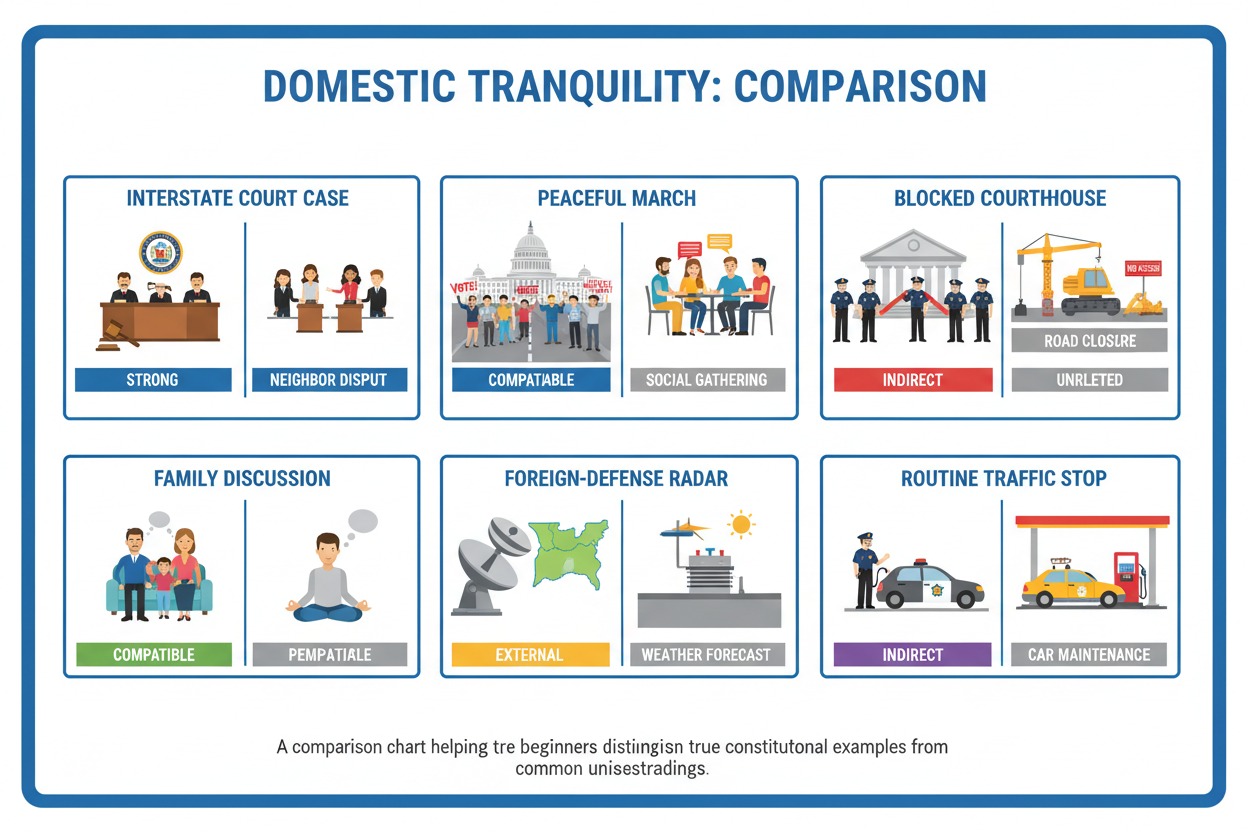
| Scenario | Domestic tranquility connection | Best explanation |
| Two states litigate a water dispute | Strong | Courts replace interstate retaliation with a binding legal process |
| A peaceful march criticizes officials | Compatible with tranquility | Protected dissent is not the same as violent disorder |
| An armed group blocks courts from operating | Strong | The conduct threatens lawful institutions and public order |
| A family has a private disagreement | Usually none | “Domestic” in the Preamble means within the nation, not inside a household |
| The nation prepares for a foreign attack | Mainly common defense | The threat is external rather than domestic |
| Police enforce an ordinary traffic law | Indirect | Routine law enforcement supports order, but not every citation needs a Preamble claim |
Benefits and risks of the domestic tranquility goal
Treating internal peace as a core purpose of government has clear benefits. People can work, travel, speak, vote, own property, and plan their lives more securely when laws are predictable and disputes do not routinely turn violent. Stable institutions also make reform possible because citizens can challenge rules without first destroying the system that hears the challenge.
The idea can also be misused if it is separated from justice, liberty, and limited power. Officials may label criticism “disorder,” use vague security claims to avoid scrutiny, or choose force before lawful alternatives have been tried. The Preamble does not excuse those choices or make them constitutional.
| Benefits of pursuing domestic tranquility | Risks when the idea is misread |
| Safer communities and functioning public institutions | Treating peaceful dissent as a security threat |
| Peaceful courts, elections, and transfers of power | Claiming powers the Constitution does not grant |
| Clear cooperation among state and national governments | Using an excessive response to a limited problem |
| Greater confidence that rights can be exercised safely | Seeking silence instead of legitimate, durable peace |
| Stable conditions for trade, education, and family life | Ignoring injustice that may fuel future conflict |
The best interpretation is neither “government must do nothing” nor “government can do anything for order.” It is a constitutional middle path: government should protect public peace through powers actually granted, fair procedures, proportionate responses, and respect for protected freedom.
Expert tips for explaining the phrase correctly
A strong explanation does not need difficult vocabulary. It needs a precise definition, one piece of historical context, one constitutional mechanism, and one limit. That combination is useful for homework, exam answers, citizenship study, and general reading.
- Define the phrase first. Say that it means securing peace and order within the nation.
- Explain “domestic.” Make clear that it means internal or within the country, not household life.
- Mention historical context carefully. Use Shays’ Rebellion as a major example, not a proven single cause.
- Separate purpose from power. State that the Preamble explains goals but does not independently grant authority.
- Protect the role of dissent. Explain that peaceful protest can coexist with, and even support, domestic tranquility.
- Connect justice with peace. Fair courts and lawful processes reduce the need for violence or retaliation.
Ready-to-use answer lengths
For a short quiz answer, write: “It means keeping peace and lawful order within the nation.” This is brief, accurate, and easy to remember.
For a stronger class answer, write: “To insure domestic tranquility means to secure peace and stability inside the nation by using laws, courts, and constitutional institutions to resolve disputes rather than violence.” This version adds the mechanism that the shortest definition misses.
For an advanced answer, write: “The phrase states a purpose of the Constitution: securing internal peace among the people, states, and institutions of the nation. It reflects concerns about unrest and weak government under the Articles of Confederation, but it does not independently grant legal power or justify suppressing peaceful dissent.”
Frequently asked questions
what does insure domestic tranquility mean?
It means securing peace, public order, and political stability inside the nation. The goal is to create conditions in which people and governments can resolve conflicts through lawful institutions rather than violence, rebellion, or retaliation.
what does it mean to insure domestic tranquility?
It means that maintaining internal peace is one of the purposes for which the Constitution was established. The word “insure” means secure, “domestic” means within the country, and “tranquility” means public peace and calm.
what does establish justice insure domestic tranquility mean?
It means creating fair legal institutions and preserving the internal peace those institutions need in order to work. Justice makes public order legitimate, while tranquility allows courts, elections, legislatures, and protected civic activity to continue.
what does to insure domestic tranquility mean?
In simple words, it means “to help keep peace at home,” where “home” refers to the nation rather than a private house. It includes lawful ways to handle serious disputes, unrest, and conflict among states or groups.
Can the government use the Preamble alone to justify an action?
No. The Preamble states purposes, but government action must be supported by a specific constitutional power or a valid law. Rights and limits found elsewhere in the Constitution still apply, including protections for due process, speech, petition, and peaceful assembly.
Conclusion
So, what does insure domestic tranquility mean in the fullest sense? It means securing internal peace through a constitutional order that can enforce law, settle disputes, coordinate governments, protect lawful civic life, and respond to serious unrest. It is about durable peace under law, not forced silence.
The historical context explains why the goal felt urgent, while the legal limits explain why the phrase is not a blank check. If you remember only one idea, remember this: domestic tranquility is not the absence of disagreement. It is the ability to live with disagreement and resolve it through fair, lawful institutions instead of violence.
If this guide helped you understand the Preamble, continue with the related explanations of constitutional supremacy and the 14th Amendment linked above. You can also share the short-answer section with a student, teacher, or anyone who wants a clear civics explanation without legal jargon.