


How a Senate Bill Becomes Law: Proper Order
What Is the Proper Order of a Bill Becoming a Law After It Is Introduced in the Senate?
When going through the process of a bill becoming a law from after it is introduced in the senate, it is easier to remember when broken down into three stages: senate consideration, house consideration, and presidential action. Typically, a bill is first introduced to a Senate committee, passes the committee, is considered on the Senate floor, then is considered in the House of Representatives, and finally is signed by the President after passing the House and Senate in identical form.
The short version is:
Senate introduction → committee review → Senate debate and vote → House consideration and vote → resolution of differences → approval of identical text → President → law or veto process.
That is a truer statement than the popular assumption that once a bill is passed in the Senate, it moves to the House and is automatically approved. There are multiple chances for a bill to be changed, postponed, voted down or never even heard of.
What Happens Immediately After a Bill Is Introduced in the Senate?
After a senator introduces a bill, it receives an identifying number beginning with S., distinguishing it from House bills, which use H.R. The legislation is then normally referred to the Senate committee or committees responsible for the policy area covered by the proposal.
For example, legislation involving agriculture may go to a committee dealing with agriculture, while a proposal concerning federal courts may be referred to the Judiciary Committee. According to the U.S. Senate’s explanation of its committee system, committees examine legislation, obtain information, consider amendments, and decide whether measures should proceed to the full Senate.
This committee stage is important because introduction alone does not guarantee that senators will ever vote on the bill.
Step 1: The Bill Goes to a Senate Committee
Committee consideration is the first major stage after introduction under the normal legislative process. Senators serving on the appropriate committee can study the proposal, request information, discuss its likely effects, and decide whether it deserves further consideration.
A committee may also send legislation to a smaller subcommittee specializing in a particular issue. Not every bill follows exactly the same procedural path, but committee review is the standard route for most legislation.
Hearings May Be Held
Committees can conduct hearings to learn more about a proposal. Government officials, researchers, industry representatives, advocacy groups, specialists, or members of the public may provide testimony depending on the subject.
Hearings do not automatically mean that the bill will advance. They are primarily a way for senators to collect information and examine potential consequences before making decisions about the legislation.
Step 2: The Committee Reviews and May Amend the Bill
A committee can consider amendments to the legislation through a process commonly known as markup. Senators may propose changes to individual provisions, add new language, delete sections, or revise how the bill would operate.
If the committee supports the legislation, it can vote to report the bill to the full Senate. The Senate explains that committees typically send approved measures back to the chamber along with information describing the bill’s purpose and provisions.
A bill that does not receive committee support may remain in committee rather than moving forward. This is one reason being “introduced” is very different from being close to becoming law.
Step 3: The Bill Becomes Eligible for Senate Floor Consideration
Once a bill has successfully moved through the committee process, it can become eligible for consideration by the full Senate. Being eligible for floor action, however, does not guarantee that Senate leaders will schedule it for debate.
Senate scheduling and procedural rules can make this part of the process more complicated than simplified classroom diagrams suggest. Bills may wait before receiving floor consideration, and some never receive a final Senate vote.
Step 4: Senators Debate, Amend, and Vote on the Bill
When the Senate takes up the legislation, senators can debate the proposal and, depending on the procedure being used, consider additional amendments. Senate procedure can involve motions, unanimous consent agreements, and rules governing how debate ends.
A final passage vote determines whether the Senate approves the bill. While a simple majority generally determines final passage when the Senate reaches that vote, getting to the vote can involve additional procedural hurdles.
The broader federal lawmaking overview from USAGov similarly explains that committee review is followed by consideration and voting in the chamber.
If the Senate rejects the bill, it does not continue toward enactment in that form. If the Senate passes it, the bill moves to the House of Representatives.
Step 5: The Bill Goes to the House of Representatives
A Senate bill does not become law simply because senators approved it. The Constitution requires legislation to pass both the Senate and the House before it can be presented to the President.
The House can consider the Senate bill through its own legislative procedures, which may include committee review, debate, amendments, and a vote. The House’s explanation of the legislative process describes the same fundamental requirement: both chambers must approve legislation before it can proceed to presidential consideration.
This creates two possible outcomes.
| What the House Does | What Happens Next |
| Passes exactly the Senate version | The bill can move toward enrollment and presidential consideration |
| Changes the Senate version | The chambers must resolve their differences |
| Rejects the bill | The bill does not advance |
| Takes no action | The bill can remain stalled |
Step 6: The House and Senate Must Agree on Identical Language
This is one of the most important parts of the process and one that short explanations often overlook. It is not enough for the Senate and House to approve bills dealing with the same subject; they ultimately need to agree to the same legislative text.
Suppose the Senate passes a bill containing Sections A, B, and C. If the House passes the bill but changes Section C, the version approved by the House is no longer identical to the Senate’s version.
The chambers must then resolve the disagreement. According to the House explanation of resolving legislative differences, one chamber may accept the other’s amendments, further amendments may be exchanged, or lawmakers may sometimes use a conference committee to negotiate a compromise.
After an agreement is reached, both chambers must approve the final identical version.
Step 7: The Approved Bill Is Sent to the President
Once the House and Senate have passed identical text, the legislation is considered enrolled and can be presented to the President. This constitutional step is known as presentment.
Article I, Section 7 of the Constitution requires a bill that has passed both chambers to be presented to the President before it becomes law. The Constitution Annotated explanation of Article I, Section 7 provides the constitutional basis for presidential approval, vetoes, and congressional veto overrides.
Step 8: The President Takes Action
After receiving an enrolled bill, the President has several possible courses of action.
- Sign the bill. It becomes law.
- Veto the bill. It returns to Congress with the President’s objections.
- Take no action while Congress remains able to receive a returned bill. After the constitutional ten-day period, excluding Sundays, the bill can become law without the President’s signature.
- Take no action when an adjournment prevents the bill from being returned. Under the appropriate circumstances, this can result in a pocket veto.
The House summarizes these possibilities in its explanation of what happens when legislation goes to the President. The constitutional rules governing the ten-day period and pocket veto are also explained in the Constitution Annotated discussion of presidential approval and veto.
Step 9: Congress Can Override a Presidential Veto
A presidential veto does not necessarily end a bill’s journey. Congress has the constitutional power to override the veto.
A successful override requires a two-thirds vote in both the House and the Senate. If both chambers reach that threshold, the legislation becomes law despite the President’s veto.
That is different from ordinary passage of most legislation, which generally requires majority approval at the final passage stage.
The Proper Order of a Bill Becoming a Law After It Is Introduced in the Senate
For a typical Senate-originated federal bill, the process can be remembered in this order:
- A senator introduces the bill.
- The bill is referred to the appropriate Senate committee.
- The committee studies the bill and may hold hearings.
- Senators on the committee may amend the bill during markup.
- The committee may report the bill to the full Senate.
- The Senate considers, debates, and may amend the bill.
- The Senate votes on final passage.
- If passed, the bill goes to the House of Representatives.
- The House considers and votes on the legislation.
- Any differences between House and Senate versions are resolved.
- Both chambers approve identical legislative text.
- The enrolled bill goes to the President.
- The President signs it, allows it to become law without a signature, or vetoes it.
- If vetoed, Congress may attempt a two-thirds override in both chambers.
The U.S. Senate’s explanation of laws and Acts confirms the essential final rule: legislation must pass both chambers in identical form and receive presidential approval, or survive a veto through the constitutional override procedure, to become law.
One Important Exception: Revenue Bills
Not every type of legislation can originate in the Senate. Article I, Section 7 states that bills for raising revenue must originate in the House of Representatives, although the Senate may propose or agree to amendments.
Therefore, when discussing a bill that was originally introduced in the Senate, remember that the Constitution places a specific origination requirement on revenue-raising legislation.
Why the Process Is More Complicated Than a Simple Flowchart
The constitutional framework sounds straightforward, but congressional procedure adds additional layers. Committees can decline to advance legislation, floor consideration can be delayed, senators and representatives can propose amendments, and disagreements between the chambers can require negotiation.
That means there is no guarantee that a bill introduced on Monday will steadily move through every remaining step. The process is deliberately structured so legislation must survive scrutiny and receive support from multiple institutions before becoming federal law.
Frequently Asked Questions
What happens first after a bill is introduced in the Senate?
A Senate bill is normally referred to the committee with jurisdiction over its subject. The committee can study it, hold hearings, consider amendments, and decide whether to send it to the full Senate.
Does a Senate bill go directly to the House after introduction?
No. Under the normal process, the Senate first considers its own bill through committee and potentially floor action. It goes to the House after the Senate passes it.
Does a bill become law after both chambers vote for it?
Only if both chambers have approved identical text, and the presidential stage is then completed. The President can sign the bill, allow it to become law without a signature under constitutional conditions, or veto it.
What happens if the House changes a Senate bill?
The amended version cannot immediately go to the President because the House and Senate have approved different language. The chambers must resolve the differences and eventually approve identical text.
Can the President reject a bill passed by Congress?
Yes. The President can veto legislation and return it to Congress with objections. Congress can still enact the bill by overriding the veto with a two-thirds vote in both chambers.
How many votes are needed to pass a bill in the Senate?
Final passage of ordinary legislation generally requires a majority of senators voting, assuming a quorum. However, Senate procedural rules can create additional hurdles before the chamber reaches a final passage vote, so the process should not always be reduced to simply “51 votes.”
Can a bill introduced in the Senate raise revenue?
The Constitution states that bills for raising revenue must originate in the House of Representatives. The Senate can propose or agree to amendments once qualifying legislation comes from the House.
Conclusion
Understanding the proper order of a bill becoming a law after it is introduced in the senate becomes much easier when you remember the three major checkpoints: approval in the Senate, approval of identical legislation in the House, and presidential action. Committee review, floor debate, amendments, reconciliation between the chambers, and a possible veto or veto override all fit within those larger stages.
For students, teachers, or anyone studying government, I recommend remembering the shortened sequence first: committee → Senate vote → House vote → identical text → President → law. Then add the committee, amendment, reconciliation, and veto details when you need a complete explanation of how federal legislation actually moves through Congress.
What Is the Proper Order of a Bill Becoming a Law After It Is Introduced in the Senate?
When going through the process of a bill becoming a law from after it is introduced in the senate, it is easier to remember when broken down into three stages: senate consideration, house consideration, and presidential action. Typically, a bill is first introduced to a Senate committee, passes the committee, is considered on the Senate floor, then is considered in the House of Representatives, and finally is signed by the President after passing the House and Senate in identical form.
The short version is:
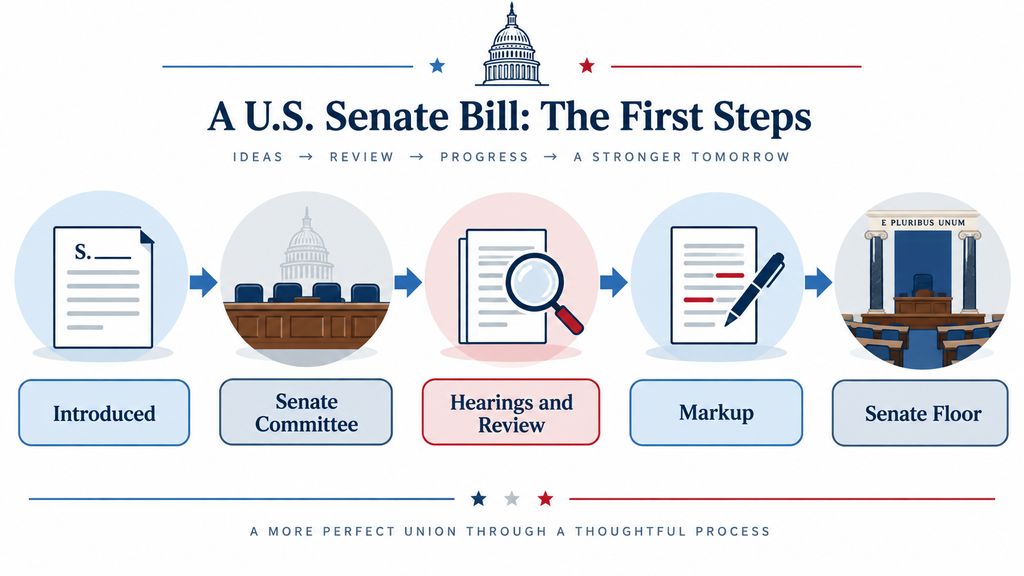
Senate introduction → committee review → Senate debate and vote → House consideration and vote → resolution of differences → approval of identical text → President → law or veto process.
That is a truer statement than the popular assumption that once a bill is passed in the Senate, it moves to the House and is automatically approved. There are multiple chances for a bill to be changed, postponed, voted down or never even heard of.
What Happens Immediately After a Bill Is Introduced in the Senate?
After a senator introduces a bill, it receives an identifying number beginning with S., distinguishing it from House bills, which use H.R. The legislation is then normally referred to the Senate committee or committees responsible for the policy area covered by the proposal.
For example, legislation involving agriculture may go to a committee dealing with agriculture, while a proposal concerning federal courts may be referred to the Judiciary Committee. According to the U.S. Senate’s explanation of its committee system, committees examine legislation, obtain information, consider amendments, and decide whether measures should proceed to the full Senate.
This committee stage is important because introduction alone does not guarantee that senators will ever vote on the bill.
Step 1: The Bill Goes to a Senate Committee
Committee consideration is the first major stage after introduction under the normal legislative process. Senators serving on the appropriate committee can study the proposal, request information, discuss its likely effects, and decide whether it deserves further consideration.
A committee may also send legislation to a smaller subcommittee specializing in a particular issue. Not every bill follows exactly the same procedural path, but committee review is the standard route for most legislation.
Hearings May Be Held
Committees can conduct hearings to learn more about a proposal. Government officials, researchers, industry representatives, advocacy groups, specialists, or members of the public may provide testimony depending on the subject.
Hearings do not automatically mean that the bill will advance. They are primarily a way for senators to collect information and examine potential consequences before making decisions about the legislation.
Step 2: The Committee Reviews and May Amend the Bill
A committee can consider amendments to the legislation through a process commonly known as markup. Senators may propose changes to individual provisions, add new language, delete sections, or revise how the bill would operate.
If the committee supports the legislation, it can vote to report the bill to the full Senate. The Senate explains that committees typically send approved measures back to the chamber along with information describing the bill’s purpose and provisions.
A bill that does not receive committee support may remain in committee rather than moving forward. This is one reason being “introduced” is very different from being close to becoming law.
Step 3: The Bill Becomes Eligible for Senate Floor Consideration
Once a bill has successfully moved through the committee process, it can become eligible for consideration by the full Senate. Being eligible for floor action, however, does not guarantee that Senate leaders will schedule it for debate.
Senate scheduling and procedural rules can make this part of the process more complicated than simplified classroom diagrams suggest. Bills may wait before receiving floor consideration, and some never receive a final Senate vote.
Step 4: Senators Debate, Amend, and Vote on the Bill
When the Senate takes up the legislation, senators can debate the proposal and, depending on the procedure being used, consider additional amendments. Senate procedure can involve motions, unanimous consent agreements, and rules governing how debate ends.
A final passage vote determines whether the Senate approves the bill. While a simple majority generally determines final passage when the Senate reaches that vote, getting to the vote can involve additional procedural hurdles.
The broader federal lawmaking overview from USAGov similarly explains that committee review is followed by consideration and voting in the chamber.
If the Senate rejects the bill, it does not continue toward enactment in that form. If the Senate passes it, the bill moves to the House of Representatives.
Step 5: The Bill Goes to the House of Representatives
A Senate bill does not become law simply because senators approved it. The Constitution requires legislation to pass both the Senate and the House before it can be presented to the President.
The House can consider the Senate bill through its own legislative procedures, which may include committee review, debate, amendments, and a vote. The House’s explanation of the legislative process describes the same fundamental requirement: both chambers must approve legislation before it can proceed to presidential consideration.
This creates two possible outcomes.
| What the House Does | What Happens Next |
| Passes exactly the Senate version | The bill can move toward enrollment and presidential consideration |
| Changes the Senate version | The chambers must resolve their differences |
| Rejects the bill | The bill does not advance |
| Takes no action | The bill can remain stalled |
Step 6: The House and Senate Must Agree on Identical Language
This is one of the most important parts of the process and one that short explanations often overlook. It is not enough for the Senate and House to approve bills dealing with the same subject; they ultimately need to agree to the same legislative text.
Suppose the Senate passes a bill containing Sections A, B, and C. If the House passes the bill but changes Section C, the version approved by the House is no longer identical to the Senate’s version.
The chambers must then resolve the disagreement. According to the House explanation of resolving legislative differences, one chamber may accept the other’s amendments, further amendments may be exchanged, or lawmakers may sometimes use a conference committee to negotiate a compromise.
After an agreement is reached, both chambers must approve the final identical version.
Step 7: The Approved Bill Is Sent to the President
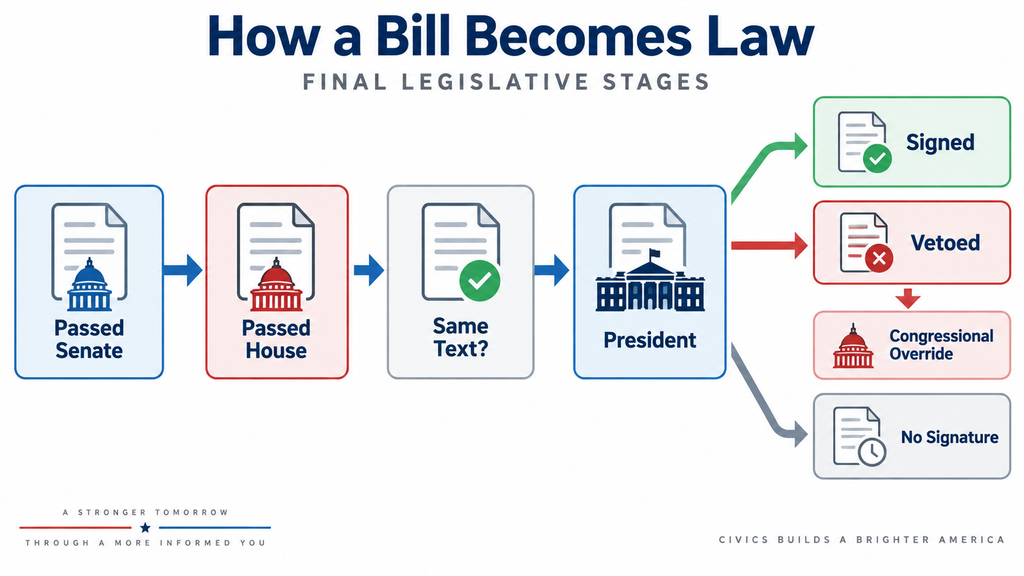
Once the House and Senate have passed identical text, the legislation is considered enrolled and can be presented to the President. This constitutional step is known as presentment.
Article I, Section 7 of the Constitution requires a bill that has passed both chambers to be presented to the President before it becomes law. The Constitution Annotated explanation of Article I, Section 7 provides the constitutional basis for presidential approval, vetoes, and congressional veto overrides.
Step 8: The President Takes Action
After receiving an enrolled bill, the President has several possible courses of action.
- Sign the bill. It becomes law.
- Veto the bill. It returns to Congress with the President’s objections.
- Take no action while Congress remains able to receive a returned bill. After the constitutional ten-day period, excluding Sundays, the bill can become law without the President’s signature.
- Take no action when an adjournment prevents the bill from being returned. Under the appropriate circumstances, this can result in a pocket veto.
The House summarizes these possibilities in its explanation of what happens when legislation goes to the President. The constitutional rules governing the ten-day period and pocket veto are also explained in the Constitution Annotated discussion of presidential approval and veto.
Step 9: Congress Can Override a Presidential Veto
A presidential veto does not necessarily end a bill’s journey. Congress has the constitutional power to override the veto.
A successful override requires a two-thirds vote in both the House and the Senate. If both chambers reach that threshold, the legislation becomes law despite the President’s veto.
That is different from ordinary passage of most legislation, which generally requires majority approval at the final passage stage.
The Proper Order of a Bill Becoming a Law After It Is Introduced in the Senate
For a typical Senate-originated federal bill, the process can be remembered in this order:
- A senator introduces the bill.
- The bill is referred to the appropriate Senate committee.
- The committee studies the bill and may hold hearings.
- Senators on the committee may amend the bill during markup.
- The committee may report the bill to the full Senate.
- The Senate considers, debates, and may amend the bill.
- The Senate votes on final passage.
- If passed, the bill goes to the House of Representatives.
- The House considers and votes on the legislation.
- Any differences between House and Senate versions are resolved.
- Both chambers approve identical legislative text.
- The enrolled bill goes to the President.
- The President signs it, allows it to become law without a signature, or vetoes it.
- If vetoed, Congress may attempt a two-thirds override in both chambers.
The U.S. Senate’s explanation of laws and Acts confirms the essential final rule: legislation must pass both chambers in identical form and receive presidential approval, or survive a veto through the constitutional override procedure, to become law.
One Important Exception: Revenue Bills
Not every type of legislation can originate in the Senate. Article I, Section 7 states that bills for raising revenue must originate in the House of Representatives, although the Senate may propose or agree to amendments.
Therefore, when discussing a bill that was originally introduced in the Senate, remember that the Constitution places a specific origination requirement on revenue-raising legislation.
Why the Process Is More Complicated Than a Simple Flowchart
The constitutional framework sounds straightforward, but congressional procedure adds additional layers. Committees can decline to advance legislation, floor consideration can be delayed, senators and representatives can propose amendments, and disagreements between the chambers can require negotiation.
That means there is no guarantee that a bill introduced on Monday will steadily move through every remaining step. The process is deliberately structured so legislation must survive scrutiny and receive support from multiple institutions before becoming federal law.
Frequently Asked Questions
What happens first after a bill is introduced in the Senate?
A Senate bill is normally referred to the committee with jurisdiction over its subject. The committee can study it, hold hearings, consider amendments, and decide whether to send it to the full Senate.
Does a Senate bill go directly to the House after introduction?
No. Under the normal process, the Senate first considers its own bill through committee and potentially floor action. It goes to the House after the Senate passes it.
Does a bill become law after both chambers vote for it?
Only if both chambers have approved identical text, and the presidential stage is then completed. The President can sign the bill, allow it to become law without a signature under constitutional conditions, or veto it.
What happens if the House changes a Senate bill?
The amended version cannot immediately go to the President because the House and Senate have approved different language. The chambers must resolve the differences and eventually approve identical text.
Can the President reject a bill passed by Congress?
Yes. The President can veto legislation and return it to Congress with objections. Congress can still enact the bill by overriding the veto with a two-thirds vote in both chambers.
How many votes are needed to pass a bill in the Senate?
Final passage of ordinary legislation generally requires a majority of senators voting, assuming a quorum. However, Senate procedural rules can create additional hurdles before the chamber reaches a final passage vote, so the process should not always be reduced to simply “51 votes.”
Can a bill introduced in the Senate raise revenue?
The Constitution states that bills for raising revenue must originate in the House of Representatives. The Senate can propose or agree to amendments once qualifying legislation comes from the House.
Conclusion
Understanding the proper order of a bill becoming a law after it is introduced in the senate becomes much easier when you remember the three major checkpoints: approval in the Senate, approval of identical legislation in the House, and presidential action. Committee review, floor debate, amendments, reconciliation between the chambers, and a possible veto or veto override all fit within those larger stages.
For students, teachers, or anyone studying government, I recommend remembering the shortened sequence first: committee → Senate vote → House vote → identical text → President → law. Then add the committee, amendment, reconciliation, and veto details when you need a complete explanation of how federal legislation actually moves through Congress.
See Also
https://ideasshelter.com/what-does-insure-domestic-tranquility-mean/