


What Is One Way a Command Economy Affects the Lives of Private Citizens?
If you have ever sat in an economics class and stared at the phrase What Is One Way a Command Economy Affects the Lives of Private Citizens?, you already know it sounds simple on paper but gets confusing fast once you try to picture it in real life. I remember the first time I actually had to answer this question for a college assignment.
I picked the textbook answer, turned it in, and got the grade. But it wasn’t until years later, when I was researching my grandparents’ stories about growing up under state control in Eastern Europe, that the answer actually clicked for me. It is not just a multiple-choice trivia line. It is a description of how millions of real people had to live, work, shop, and plan their futures.
Let me explain it simply, like I wish someone had told me before: a command economy affects people’s lives by taking away their freedom to make most economic choices. You don’t get to pick your job freely. You don’t choose what to buy from a few options. You don’t decide how much to charge for your work. Instead, the government or a small group of planners makes those decisions for everyone at the same time.
This fact affects almost every part of daily life. In this guide, I will explain how, using real history, real numbers, and some of my own thoughts. I will also show where a command economy overlaps with a mixed economy, why some countries still use parts of this model today, and what it feels like based on stories from people who lived it.
Quick Answer Box
Before we go deep, here is the short version you can screenshot for a quiz or a quick reference:
- The core effect: Citizens cannot make most economic decisions for themselves. The government decides what gets produced, who works where, and how goods get priced and distributed.
- The knock-on effects: Limited job choice, restricted consumer goods, shortages and waiting lists, little room for entrepreneurship, and reduced personal financial freedom.
- The trade-off: In exchange, some command economies have offered guaranteed employment and free basic services, though usually at lower quality and with far less variety than in a market system.
Now let’s unpack all of that properly.
What Is a Command Economy, in Plain Language?
A command economy, sometimes called a planned economy, is a system where a central authority (usually the national government) owns or directs most of the country’s resources and makes the major decisions about production and distribution. Instead of prices moving up and down based on supply and demand, a central planning committee decides in advance what factories will produce, how many units, and at what price.
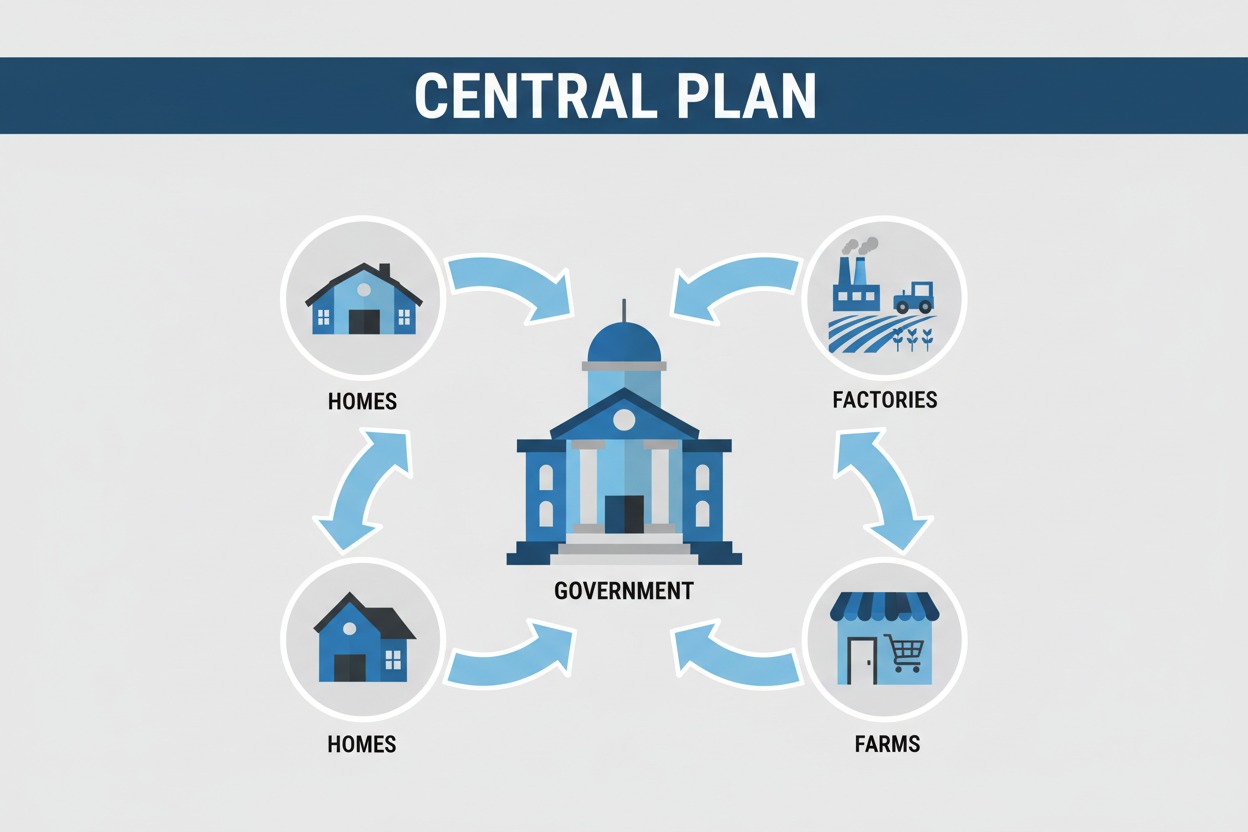
According to Kids Britannica’s explanation of command economies, the means of production are owned by the public. A central authority sets production goals and gives raw materials to businesses. This means consumers only get to choose from the goods that planners have already decided to make. Think about that for a moment. You are not choosing what to create. You are choosing from what was already made for you.
This is different from a market economy, where businesses decide what to produce based on what people are willing to buy, and prices adjust naturally. It is also different from a traditional economy, where customs and roles passed down through generations shape economic life. A command economy replaces both of those signals, price and custom, with a plan.
The Direct Answer: How It Restricts Everyday Choice
So let’s go back to the actual question one more time, because I want to be precise about it. What is one way a command economy affects the lives of private citizens? The clearest, most textbook-correct answer is this: citizens lose the ability to make most of their own economic decisions, including what job to take, what to buy, and how to spend or save their money.
This is not a minor inconvenience. Think about how many decisions you make in an average week that touch money or work. What to eat for dinner. Whether to switch jobs. Whether to start a side business. Where to shop for a jacket. In a command economy, a huge share of those choices get made somewhere else, by someone you will likely never meet, based on a five-year plan instead of your personal preference.
I explain it to friends like this: imagine your whole town shares one shopping list, made once a year by a group, and stores can only sell what is on that list. You might get flour, soap, and a coat. You can’t choose the brand, color, or sometimes even the size you need. This is how daily shopping worked in many command economies. For example, Helpful Professor’s breakdown of real-world command economy examples shows that Cuba’s government still controls much of the country’s food supply, even after many small changes.
My Own Experience Researching This Topic
I will be honest with you: I am not old enough to have lived under full central planning myself, but I have interviewed family members who grew up in a Soviet-era command economy, and I spent a good chunk of last year going through primary accounts and economic data for a separate research project. Two things surprised me.
First, I expected the biggest complaint to be about poverty. It wasn’t. The biggest complaint, over and over, was about waiting. Waiting in line for bread. Waiting years for a refrigerator. Waiting for a housing assignment that might never come through. The system was not always about having nothing. It was about having no control over when or whether you got what you needed.
Second, I saw how important career choice was to people once they got it. One relative said she was given a factory job she didn’t want because of the region’s labor quota that year. She said the day she was finally allowed to pick her own job was one of the most important days of her adult life. This detail never appeared in any textbook I read at school, and it made the topic feel real to me instead of just an idea.
If you are researching your own family history or a school project on this topic, I would genuinely recommend talking to someone who lived through it if you can. Numbers and definitions only tell you so much.
Command Economy vs Market Economy vs Mixed Economy
Here is a simple comparison table to keep the three main systems straight, since a lot of confusion around this topic comes from mixing them up.
| Feature | Command Economy | Market Economy | Mixed Economy |
|---|---|---|---|
| Who decides what gets produced | Government/central planners | Businesses, based on consumer demand | Both government and private businesses |
| Who sets prices | Central planners | Supply and demand | Mostly supply and demand, with some regulation |
| Job choice | Limited, often assigned | Chosen freely by workers | Mostly free, with labor laws |
| Property ownership | Mostly state-owned | Mostly private | Mixed public and private |
| Common examples today | North Korea, and elements in Cuba | Very few pure examples exist | United States, most of Europe, Japan |
| Main advantage | Fast mobilization, reduced inequality on paper | Innovation, variety, efficiency | Balance of stability and freedom |
| Main disadvantage | Shortages, low innovation, reduced freedom | Inequality, boom-bust cycles | Can be slower to change policy |
As Geography Worlds points out, North Korea is generally considered the closest thing to a pure command economy operating today, while Cuba, China, and Vietnam retain significant elements of central planning inside otherwise mixed systems.
The Full Picture: Every Way a Command Economy Touches Daily Life
The restriction on personal economic decisions is the headline answer, but it plays out in several very specific, very human ways. Let me walk through each one.
1. Limited Career and Job Choice
In a command economy, jobs are planned by the government. The state decides how many welders, teachers, or farmers are needed in a region and assigns people to those jobs. Personal skills or interests matter less than what the plan needs that year. This takes away the freedom to change careers, apply for jobs you want, or start a business when you see an opportunity.

2. Restricted Consumer Choice and Shortages
Because production quotas are set in advance, they rarely match real-time demand. This creates the classic pattern of shortages in some goods and surpluses in others. Wall Street Prep’s overview of command economy characteristics explains that this mismatch between planned output and actual demand is one of the most consistent outcomes of centrally planned systems, regardless of the country or decade.
I think about this every time I stand in a grocery store aisle comparing five brands of the same product. That small, almost boring moment of choice is something people under strict command economies simply did not get to experience for most everyday goods.
3. Healthcare and Education, Provided but Limited
Many command economies promise free healthcare and education, and to their credit, some have delivered wide access. Cuba is often cited as an example of universal coverage funded by the state. But access is not the same as quality or choice. Citizens usually cannot choose their doctor, their school, or the specific type of care they receive, because the system is designed around uniform provision rather than individual preference.
4. Housing and Property
In many command economies, private property in land and major resources is limited or nonexistent. Housing is often assigned rather than bought or rented on an open market, which means your address, your neighborhood, and even your neighbors can be decided for you rather than chosen by you.
5. Almost No Room for Entrepreneurship
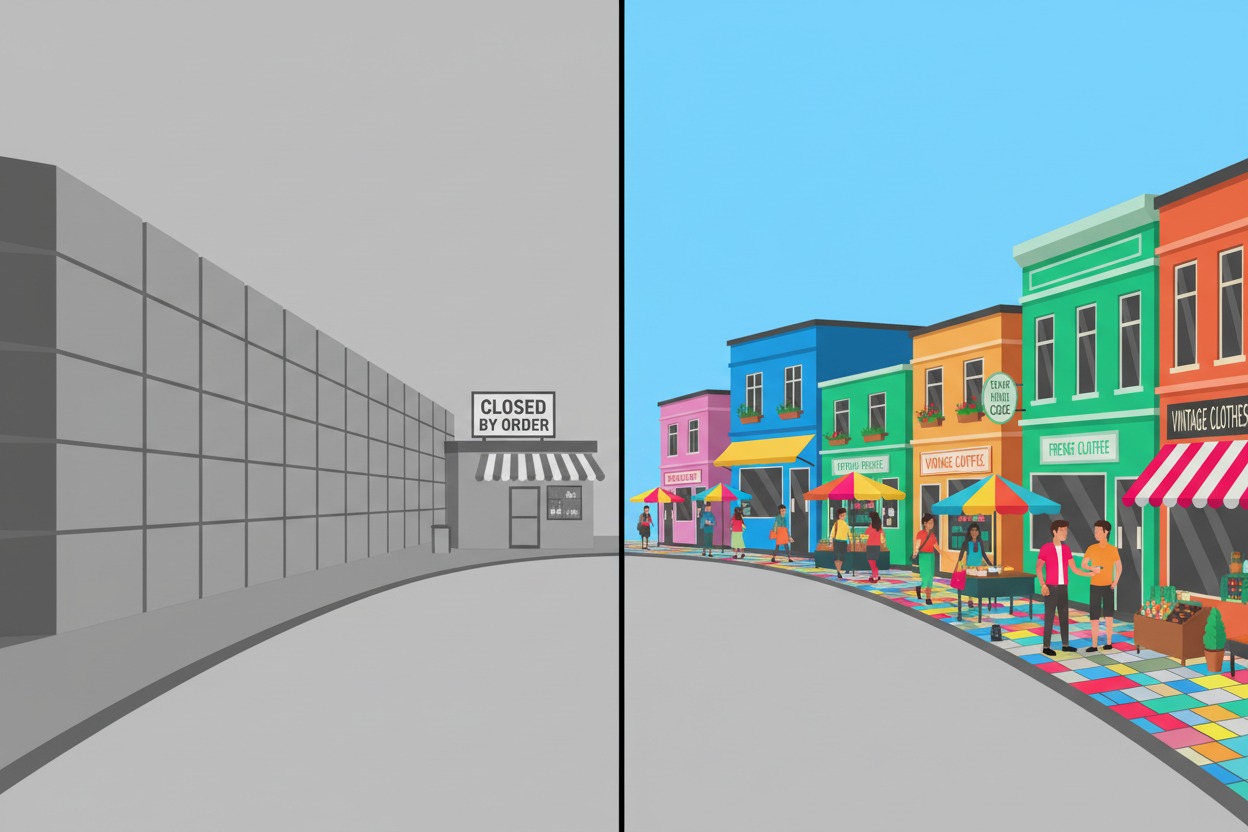
If you have ever thought about starting a small business, a side job, or selling something you made, you know why this matters. A command economy usually allows very little legal space for private businesses because production is planned by the government. According to Finance Strategists’ explanation of command economy characteristics, the government owns the main industries and makes any private businesses follow the central plan closely. This leaves little chance or legal space for personal effort.
6. Reduced Personal Financial Freedom
Wages, savings options, and even what you are allowed to do with your money can be tightly controlled. Without competing employers or a real labor market, workers usually have little leverage to negotiate pay, and there are often few options for investing, starting a business, or building wealth outside the state system.
Why Do Governments Choose a Command Economy in the First Place?
It is worth pausing here, because this system did not appear out of nowhere. Most command economies were built in response to a crisis: war, revolution, or extreme poverty, where leaders believed a market system was too slow or too unequal to fix the problem fast enough. Central planning promised something appealing on paper, a coordinated national effort where every factory, farm, and worker pulls toward the same goal instead of competing against each other.
In the early Soviet Union, this meant rapid industrialization within a couple of decades, taking a mostly agricultural country and turning it into a major industrial power. In post-revolution Cuba, it meant redistributing land and resources away from a small wealthy class. In North Korea, it has meant total state control justified as national self-reliance. The intention, in each case, was rarely “let’s make citizens’ lives harder.” It was “let’s solve a big national problem quickly, even if it means individuals give up control.”
That context matters because it explains why the trade-off happens at all. Citizens are not losing economic freedom for no reason. They are losing it because planners decided collective goals should outrank individual choice. Whether that trade worked out depends entirely on which country and which decade you look at, and that is exactly why the case studies below matter so much.
How This Shows Up in Smaller, Everyday Ways
Beyond the big categories like jobs and healthcare, a command economy shapes dozens of small daily moments that are easy to overlook if you have never experienced them.
- Grocery shopping becomes unpredictable. Instead of checking a store’s hours, citizens often had to check whether a shipment had arrived at all that week.
- Saving money loses some of its purpose. With few consumer goods to spend on and limited investment options, saving does not carry the same reward it does in a market economy.
- Moving cities is harder. Housing assignments and residency permits, common tools in command economies, made it difficult to simply relocate for a better opportunity, because opportunities themselves were centrally distributed.
- Complaining through the market disappears. In a market economy, if you dislike a product or a company’s prices, you can simply buy from someone else. In a command economy, there is often only one seller, the state, so that kind of everyday consumer power does not exist.
I find this last point especially interesting, because it is easy to underestimate how much power “just go somewhere else” gives you as a shopper or a worker. A command economy quietly removes that option almost everywhere at once.
Real-World Case Studies
Numbers and definitions are useful, but real examples make this topic stick. Here are four well-documented cases.
The Soviet Union
The USSR remains the largest and most studied command economy in history. Central planners set output quotas across every sector of the economy. According to Geography Worlds, Soviet planners once calculated that fully optimizing the planned economy in real time would have required more calculations per second than there are atoms in the known universe, which gives you a sense of just how unmanageable full central planning becomes at national scale.
North Korea
North Korea is widely regarded as the closest example of a pure command economy still operating today. The Heritage Foundation’s Economic Freedom Index, summarized by World Population Review, gave North Korea the lowest economic freedom score of any country measured, at just 2.90 out of 100, reflecting almost total state control over economic life and virtually no room for private economic decision-making.
Cuba
Cuba’s command economy dates back to the 1959 revolution. Even with gradual market reforms since 2011, the government still directly employs roughly three-quarters of the workforce and rations a large share of the national food supply, according to Helpful Professor’s country-by-country review. Cuba’s Economic Freedom Index score sits at 24.30, the second lowest in the world after North Korea, per the same World Population Review data.
East Germany
East Germany operated a Soviet-style command economy from the late 1940s until reunification in 1990. It achieved strong industrial output and near-universal employment, but daily life still involved long queues for consumer goods and years-long waits for items like cars, and the Berlin Wall itself became a physical symbol of the restrictions that came with the system.
At-a-Glance Comparison
| Country | Status Today | Economic Freedom Score | Notable Citizen Impact |
|---|---|---|---|
| North Korea | Closest to a pure command economy | 2.90 (lowest globally) | Near-total state control over jobs, goods, and movement |
| Cuba | Command economy with limited reforms since 2011 | 24.30 | ~75% of workforce state-employed, food rationing |
| Former USSR | Dissolved in 1991, transitioned to mixed/market | N/A (historical) | Central planning collapse led to major economic transition |
| East Germany | Reunified with West Germany in 1990 | N/A (historical) | Full employment paired with chronic consumer shortages |
| Belarus | Heavily state-controlled, mixed elements | Low (repressed category) | Government owns roughly 70% of businesses, 75% of banks |
Pros and Cons of a Command Economy
To keep this balanced, here is a fair look at both sides, because command economies were not designed to make people miserable. They were designed to solve real problems, even if the trade-offs turned out to be steep.
Potential advantages:
- Governments can mobilize resources quickly toward a single national goal, such as rapid industrialization.
- Employment can be guaranteed across the population, at least on paper.
- Wealth inequality can be reduced compared to unregulated markets, since profit is not the driving incentive.
- Basic services like healthcare and education can be extended to everyone, regardless of income.
Common disadvantages:
- Personal and economic freedom is significantly reduced, from job choice to consumer goods.
- Shortages and surpluses are common, since planners cannot perfectly predict real demand.
- Innovation tends to slow down without competition or profit incentives driving new ideas.
- Bureaucracy and inefficiency tend to grow over time, as noted in several independent analyses of historical command economies.
- Black markets often emerge as a workaround, since citizens still want goods and services the official plan does not provide, which is well documented in modern North Korea, where unofficial trading has become a significant part of how households actually get by.
Command economies are not always linked to one political ideology, although most real examples have been socialist or communist. Some economists say that a command economy aimed only at using resources efficiently, without strict political control, would look different from what we have seen. In reality, centralized economic control usually comes with centralized political control. This is why limited choices, less free speech, and reduced movement often happen together, not separately.
Lessons for Today
Even if you never live in a full command economy, knowing how it works can help explain debates in market-based countries. Talks about government healthcare, national industry plans, price controls in emergencies, or big public projects all use ideas from command economies, but applied in smaller ways within a market system.
One useful way to study this topic is to see “command economy” not just as history but in real life. In mixed economies, during crises, we see command-style actions like wage and price controls, rationing in war, or state-led manufacturing in health emergencies. These examples show the benefits and limits of centralized control without going back to the Soviet Union.
Expert Tips for Understanding This Topic (Whether You’re Studying or Just Curious)
- Separate the theory from the outcome. A command economy is designed to maximize social welfare and equal access. In practice, most real-world attempts struggled with inefficiency and shortages, so it helps to evaluate the intention and the result as two separate things.
- Look at hybrid systems, not just extremes. Very few countries today run a pure command economy. Most, including China and Vietnam, blend central planning with market mechanisms, which is why economists usually describe them as mixed economies with strong state influence.
- Use real data, not just definitions. Comparing Economic Freedom Index scores, like North Korea’s 2.90 versus a country like Switzerland’s much higher score, gives you a concrete way to measure how restrictive a system really is instead of relying on abstract descriptions.
- Connect it back to your own choices. If you want this topic to actually stick, try listing five economic decisions you made this week (a purchase, a work choice, a savings decision) and imagine which of those you would still be allowed to make freely under strict central planning. It makes the concept far less abstract.
If you enjoy this kind of practical, real-life framing for big concepts, you might also like our piece on how short-term goals lead to long-term career success, since career freedom, the very thing a command economy restricts, is a huge part of building a career you actually want.
Frequently Asked Questions
1. What is one way a command economy affects the lives of private citizens?
The most direct effect is that citizens cannot make most economic decisions for themselves. The government controls what gets produced, how goods are priced, and often which jobs people are assigned to, which limits personal and financial freedom across daily life.
2. Does a command economy guarantee employment?
Many command economies have aimed for full employment by assigning jobs directly through central planning. However, guaranteed employment does not always mean workers get to choose their profession, their employer, or their wages.
3. Are there any countries with a pure command economy left today?
North Korea is generally considered the closest example of a pure command economy still in operation, while countries like Cuba, China, and Vietnam blend central planning with elements of a market economy.
4. How is a command economy different from a mixed economy?
A command economy places nearly all major economic decisions in the hands of the government. A mixed economy, like the one used in the United States, combines private enterprise and free markets with government regulation and public services.
5. What are the biggest disadvantages of a command economy for regular people?
The most commonly documented disadvantages include restricted job choice, limited consumer goods, chronic shortages, reduced entrepreneurship, and less control over personal finances and property compared to a market-based system.
Final Thoughts
Here is what I want you to take away from all of this. What is one way a command economy affects the lives of private citizens? It strips away the everyday economic decisions most of us barely think twice about, from picking a job to choosing what to put in your cart at the store. That single shift changes almost everything else downstream, from how people plan their futures to how much room they have to try something new.
I did not fully appreciate how much freedom of choice matters until I heard my own family describe living without it. If this topic interests you, I would encourage you to go beyond the definition and look at the real human stories behind it, whether that is through documented history, family accounts, or current reporting on countries like North Korea and Cuba. It turns a textbook answer into something you actually understand.
If you found this breakdown useful, explore more of our business and economics coverage here on Ideas Shelter, and feel free to share this guide with a classmate, student, or anyone brushing up on economic systems for a test or just out of curiosity.
Cover Image Prompt
A modern, blog-style thumbnail composition: a split image with a grey, muted cityscape on the left showing a factory and a government building connected by directional arrows (representing central planning), and a vibrant, colorful street market on the right (representing free choice). Bold, clean sans-serif text overlay reading “Command Economy: How It Really Affects You,” in white with a dark contrast bar for readability. Aspect ratio suited for a blog header and YouTube-style thumbnail (16:9). ALT TEXT: “Cover image comparing a command economy with restricted choice to a free market with consumer variety”