


What Is a Prenup? A Plain-English Guide for Couples
Somewhere between picking a wedding venue and choosing a font for the invitations, many couples hit an awkward moment: someone brings up the word “prenup.” The room gets quiet. Someone laughs nervously. And then, usually, nobody actually explains what the thing is.
So let’s fix that.
A prenup isn’t a betrayal detector, and it isn’t just for celebrities with mansions in the Hamptons. It’s a legal tool — and increasingly, a fairly normal one. In fact, support for prenups has climbed to roughly half of U.S. adults, according to a Harris Poll conducted for Axios, up from 42% in the previous year.
This guide breaks down exactly what a prenup is, what it can and can’t do, what a “fair” one actually looks like, and how much the whole process realistically costs — no legal jargon, no fear-mongering.

What Is a Prenup, Exactly?
A prenup — short for prenuptial agreement — is a written contract two people sign before their wedding day. It spells out how money, property, and debt will be handled if the marriage ever ends in divorce or if one spouse passes away.
Think of it less like a divorce plan and more like a financial owner’s manual for the marriage. It answers questions like:
- Whose assets stay separate, and whose become shared?
- Who’s responsible for the debt one partner brought into the marriage?
- What happens to a family business if the marriage doesn’t work out?
- Will one spouse receive spousal support (alimony), and if so, how much?
Without a prenup, all of these questions get answered later by state law — and every state has different default rules for dividing property in a divorce. A prenup lets a couple decide those terms themselves, ahead of time, while they’re calm, informed, and on good terms.
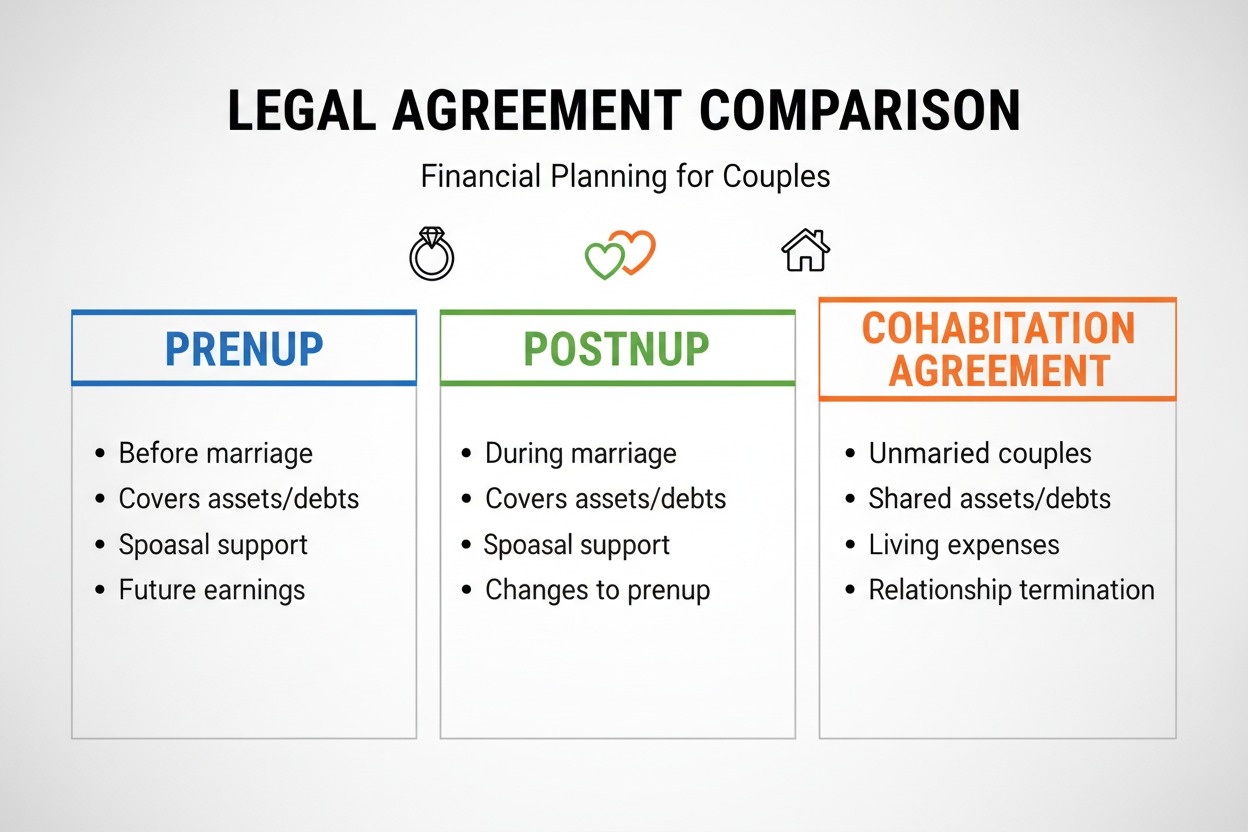
Prenup vs. Postnup vs. Cohabitation Agreement
It’s easy to mix these up, so here’s a quick side-by-side.
| Agreement Type | When It’s Signed | Who It’s For |
|---|---|---|
| Prenuptial agreement (prenup) | Before the wedding | Engaged couples planning to marry |
| Postnuptial agreement (postnup) | After the wedding | Already-married couples |
| Cohabitation agreement | Any time | Unmarried couples living together, as outlined by resources like LawDepot |
What Does a Prenup Actually Cover?
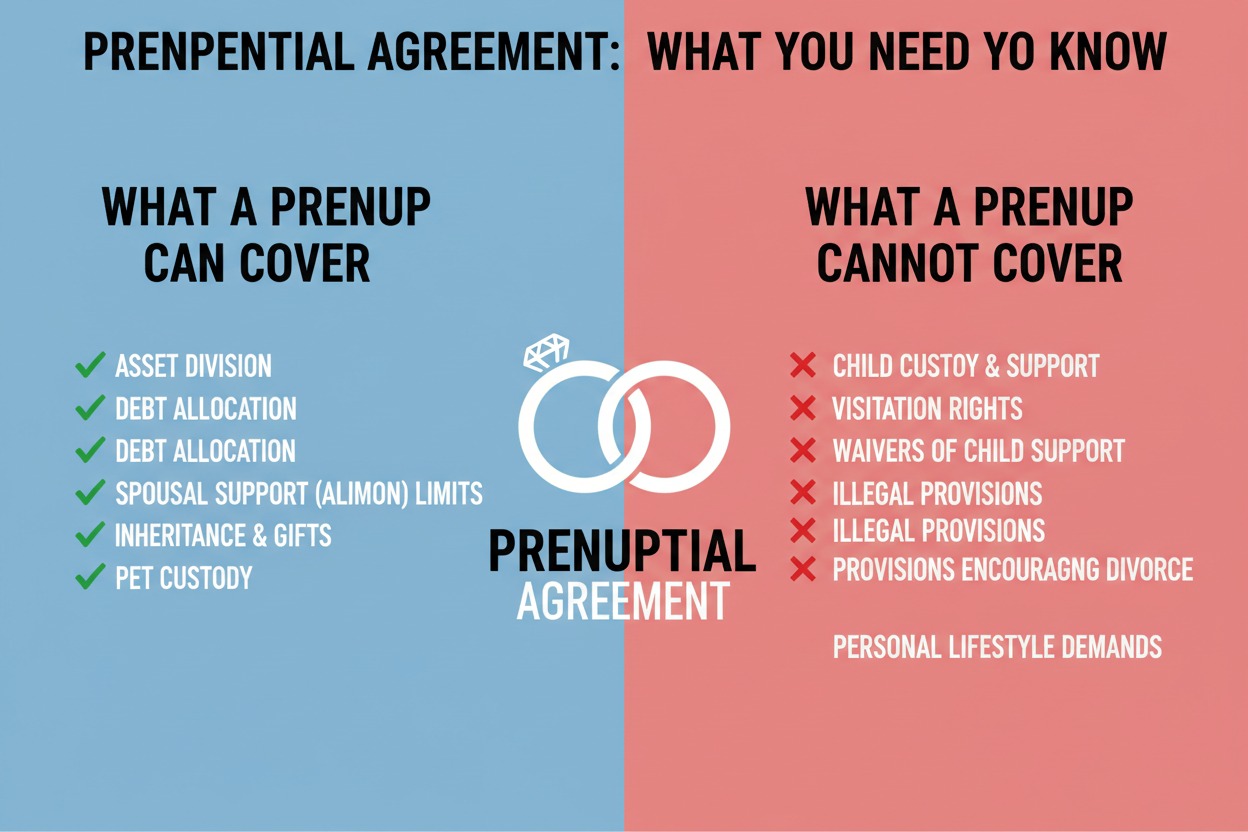
A well-written prenuptial agreement typically addresses:
- Division of property — what’s “separate property” (owned before marriage) versus “marital property” (built together)
- Debt responsibility — protecting one spouse from the other’s pre-existing debt
- Business ownership — keeping a family business or startup out of a potential divorce dispute
- Inheritance protection — making sure inherited assets stay with the intended family line
- Spousal support terms — setting expectations for alimony in advance
- Death provisions — clarifying what happens to assets if a spouse dies during the marriage
What a Prenup Cannot Do
This part matters just as much. Courts across the country will strike down or ignore prenup clauses that try to control things a contract legally has no business controlling. A prenup cannot:
- Determine child custody or child support (courts decide this later, based on the child’s best interests)
- Include anything illegal or against public policy
- Dictate personal, non-financial matters like chores, weight, or how often you visit in-laws
- Be signed after the wedding (at that point, it becomes a postnup instead)
If you’ve seen a prenup online with a clause about “spouse must maintain a certain weight” or similar, that’s a myth or an unenforceable novelty clause — not something a real court would honor.
Why Do People Get Prenups?
The stereotype is that prenups are only for the ultra-wealthy, protecting a fortune. The reality has shifted quite a bit.
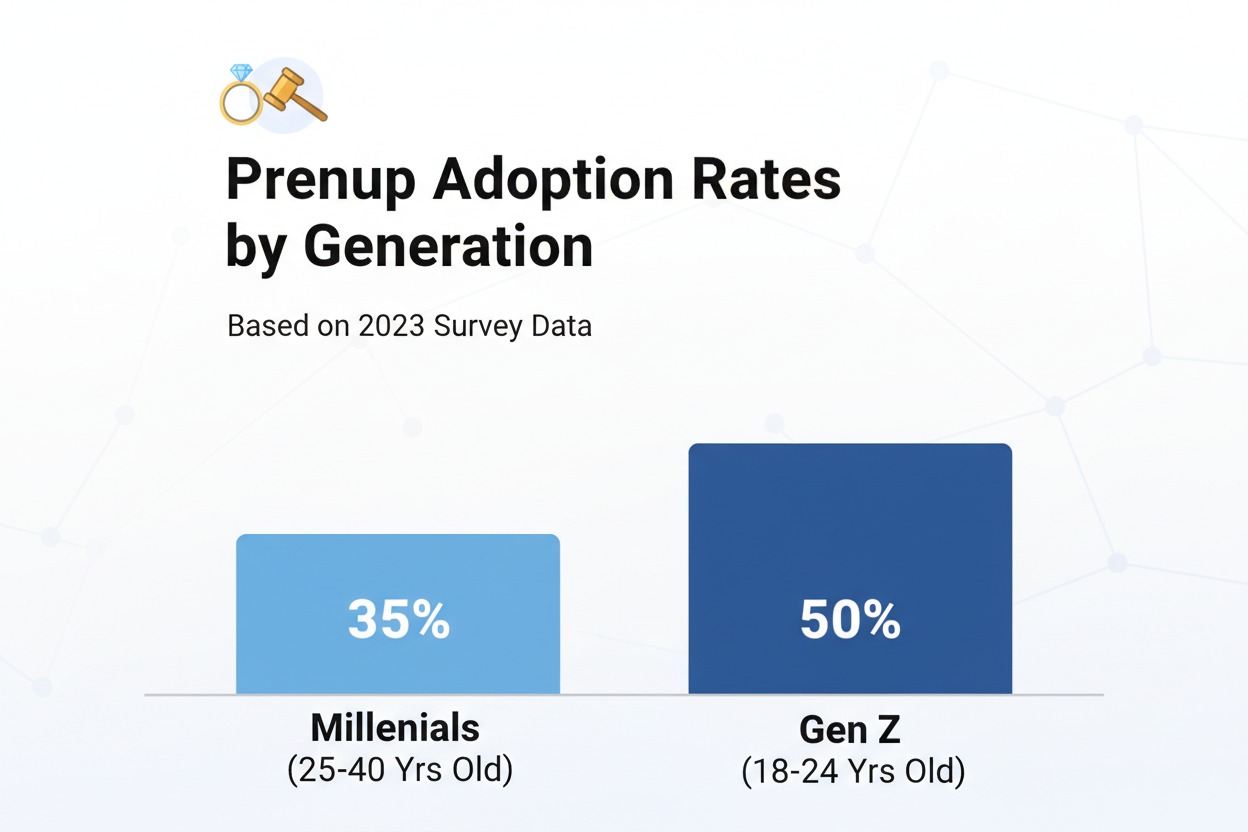
According to prenup research summarized by Cyrus Pacific Law, the share of married or engaged Americans who had signed a prenup jumped from just 3% in 2010 to 15% in 2022 — a fivefold increase in about a decade. Younger generations are driving much of that shift: separate polling cited by Axios found that roughly 47% of engaged or married millennials and 41% of Gen Z respondents said they’d entered into a prenup.
A few real-world reasons keep coming up:
- Marrying later in life. People are marrying later than previous generations, which means more of them already have careers, retirement accounts, and property before the wedding even happens.
- Second marriages. Prenups are especially common for people remarrying, particularly if they have children from a previous relationship whose inheritance they want to protect.
- Business ownership. Entrepreneurs increasingly use prenups to ensure a divorce doesn’t threaten the company they built.
- Debt protection. One partner may want to shield the other from student loans or other debt they’re carrying into the marriage.
- Open financial conversations. Younger couples are more willing to talk about money early, treating a prenup as a planning tool rather than a taboo subject.
Prenup Statistics Snapshot
| Statistic | Figure |
|---|---|
| Adults who support prenups (2023) | ~50% |
| Married/engaged adults who’ve signed one (2022) | ~15% |
| Millennials who’ve entered a prenup | ~47% |
| Gen Z (engaged/married) who’ve entered a prenup | ~41% |
| Prenup rate in 2010 | ~3% |
Sources: Harris Poll via Axios; Cyrus Pacific Law
What Is a Fair Prenup? (This Is the Part People Actually Worry About)
Here’s the honest answer: “fair” doesn’t mean identical, and it doesn’t mean 50/50 in every category. A fair prenup is one where both partners fully understand it, both had a real chance to negotiate it, and neither was pressured or rushed into signing.
Courts look for a few specific things when deciding whether to enforce a prenup, and these double as a solid checklist for fairness:
- Full financial disclosure. Both partners disclosed their income, assets, and debts honestly. Hiding assets is one of the fastest ways to get a prenup thrown out later.
- Independent legal counsel. Each partner ideally has their own attorney — not one lawyer representing both people. This protects both sides and strengthens enforceability.
- No signing under pressure. A prenup handed over the night before the wedding, with a “sign it or the wedding’s off” energy, is a red flag courts take seriously. Give it weeks, not hours.
- Reasonable terms. An agreement that leaves one spouse with literally nothing, regardless of how long the marriage lasts, is far more likely to be challenged and rejected.
- Written and properly executed. It has to be in writing and signed according to your state’s requirements — a verbal understanding doesn’t count.
A Simple “Is This Fair?” Gut Check
- Did both of you have time to actually read it — not skim it the week of the wedding?
- Did you each have your own lawyer, or at least the real opportunity to get one?
- Were you both honest about what you own and owe?
- Would you still feel okay about these terms if the marriage lasted 25 years, not 2?
If you can answer “yes” to all four, you’re likely looking at something a court would recognize as fair — and something you can both feel good about signing.
How Much Does a Prenup Cost?
Costs vary a lot depending on who drafts it and how complicated your finances are.
- Attorney-drafted prenups can run from several hundred dollars into the thousands, especially for high-asset or business-owner situations. This tracks with legal industry pricing data — the Bureau of Labor Statistics reports a median annual wage for lawyers of over $150,000, and the going hourly rate for family law attorneys nationally runs into the hundreds of dollars.
- Flat-fee online platforms have emerged specifically to make prenups more accessible, with some charging a flat fee in the range of a few hundred dollars rather than hourly billing, according to reporting from Axios.
Complexity drives the price more than anything else. A simple agreement between two people with modest, straightforward finances costs far less than one involving a business, multiple properties, or a blended family with prior child support obligations.
How to Actually Bring It Up With Your Partner
This is often the hardest part — harder than any legal clause. A few things tend to help:
- Bring it up early, not two months before the wedding. Early conversations feel like planning; last-minute ones feel like ultimatums.
- Frame it as mutual protection, not suspicion. It’s closer to insurance than to a prediction of failure.
- Talk about money in general first. Debt, spending habits, financial goals — a prenup conversation lands much better inside a broader, ongoing money conversation than as a cold open.
- Expect it to take a few conversations. Rushing this topic is exactly what creates the tension people are afraid of in the first place.
Expert Tips for a Smoother Prenup Process
- Get your own attorney. Even if it feels like “extra cost,” independent counsel is one of the biggest factors in whether a prenup holds up later.
- Disclose everything, even the awkward stuff. Old debt, a lingering student loan, a side business — leaving it out can undo the entire agreement down the road.
- Revisit it if your life changes drastically. A career change, inheritance, or new business might mean it’s time for an update (via a postnup, since a prenup can’t be edited after the wedding).
- Don’t copy a template blindly. State laws differ significantly, and a prenup that’s ironclad in one state may have unenforceable clauses in another.
- Keep the tone collaborative. The couples who report the smoothest experience treat the prenup like a joint financial planning project, not a negotiation between adversaries.
Pros and Cons of Getting a Prenup
| Pros | Cons |
|---|---|
| Clarifies asset division ahead of time, reducing future conflict | Can feel emotionally uncomfortable to bring up |
| Protects a business, inheritance, or pre-marital assets | Costs money, especially with independent attorneys |
| Can speed up and simplify a future divorce, if one happens | Requires full financial transparency, which some people resist |
| Encourages open, early money conversations | Poorly drafted agreements can be challenged or thrown out |
| Can be tailored to your specific situation | Can’t cover child custody or child support |
“What Is a Prenup in BitLife?”
Worth a quick note, since a lot of people search this exact phrase: in the life-simulation game BitLife, a prenup works similarly to real life — it’s an in-game agreement you can set up before marriage that determines how your character’s assets get split if the in-game marriage ends in divorce. It’s a simplified, gamified version of the real legal concept, letting players decide in advance whether their character’s money and property stay protected. It’s a fun way the game mirrors a real financial planning tool, even if the mechanics are obviously much simpler than an actual legal document.
FAQs About Prenups
1. What is a prenup agreement in the simplest terms?
It’s a legal contract signed before marriage that decides how assets, debts, and property will be divided if the marriage ends, instead of leaving those decisions entirely up to state law.
2. Does getting a prenup mean we’re planning to get divorced?
No. Most legal and financial resources frame it more like insurance — planning for a range of outcomes doesn’t mean you expect the worst one.
3. Can a prenup be changed after the wedding?
Not directly. Once you’re married, changes are made through a separate document called a postnuptial agreement, which both spouses must agree to.
4. Is a prenup only for wealthy people?
Not anymore. Younger couples increasingly use them to protect debt situations, career earnings, and smaller estates — not just large fortunes.
5. What makes a prenup unfair or unenforceable?
Hiding assets, pressuring a partner to sign right before the wedding, denying someone the chance to get their own attorney, or including illegal or unconscionable terms can all get a prenup thrown out in court.
Final Thoughts
A prenup isn’t about assuming your marriage will fail — it’s about making sure both people walk into it with clear eyes, honest numbers, and a shared understanding of what happens next, no matter what “next” looks like. Whether you’re weighing a prenup because of a business, a previous marriage, or just wanting an honest money conversation before the wedding, the healthiest approach is the same: start early, be transparent, and get advice from a qualified family law attorney in your state before you sign anything.
This article is for general informational purposes and isn’t legal advice. Prenup laws vary by state, so talk to a licensed family law attorney about your specific situation.
Ready to think it through with your partner? Start the conversation this week — not the week before the wedding.
Also Read: What Is a Viscount? Rank, History & Meaning Explained
What Is a Viscount? Rank, History & Meaning Explained