


What Does the 14th Amendment Say? A Complete, Plain-English Breakdown
Few parts of the U.S. Constitution touch daily life as much as the 14th Amendment — and few are as widely referenced yet actually unread. It’s the amendment behind landmark Supreme Court cases like Brown v. Board of Education and Loving v. Virginia, and it’s the constitutional basis for the citizenship of virtually every American born on U.S. soil.
So what does it actually say? The 14th Amendment contains five sections, covering citizenship, due process, equal protection, congressional representation, disqualification from office for insurrection, public debt, and Congress’s power to enforce it all. This guide walks through the full text of each section of the Constitution, in the Constitution’s own words, with a plain-language explanation of what it actually means.
What Does the 14th Amendment to the Constitution Say? The Basics
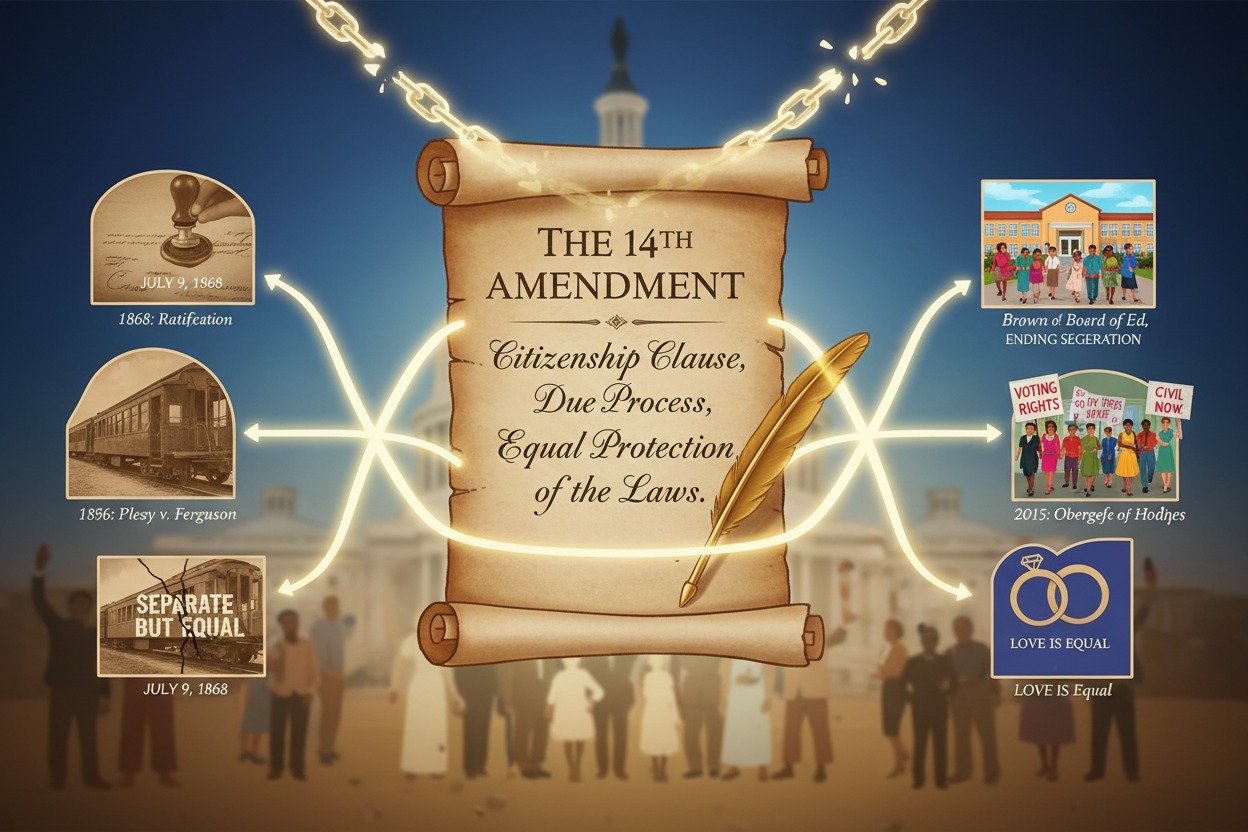
The 14th Amendment was passed by Congress on June 13, 1866, and ratified on July 9, 1868, according to the National Archives. It was the second of three Reconstruction-era amendments, adopted in the aftermath of the Civil War specifically to secure the rights of formerly enslaved people and dismantle the legal remnants of slavery.
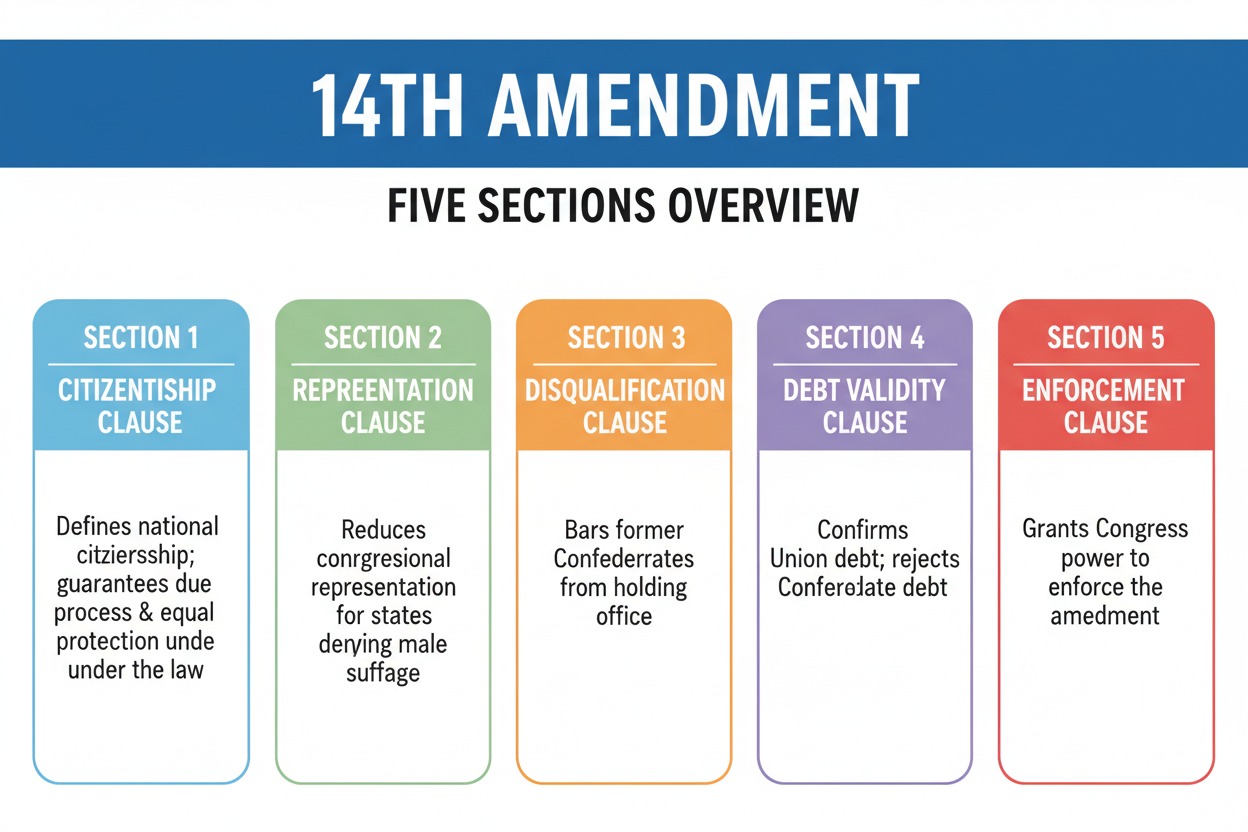
The amendment’s five sections address, in order:
- Citizenship, due process, and equal protection
- How congressional representatives are apportioned among the states
- Disqualification from office for those who engaged in insurrection
- The validity of public debt
- Congress’s power to enforce the amendment
Of these, Section 1 carries by far the most weight in modern American law and daily life — it’s the basis for more Supreme Court litigation than any other single constitutional provision, according to legal analysis from LegalClarity.
What Does the 14th Amendment Say About Citizenship? (Section 1)
This is the section most people are actually asking about when they search this question. Here is the exact text, as published by the National Constitution Center:
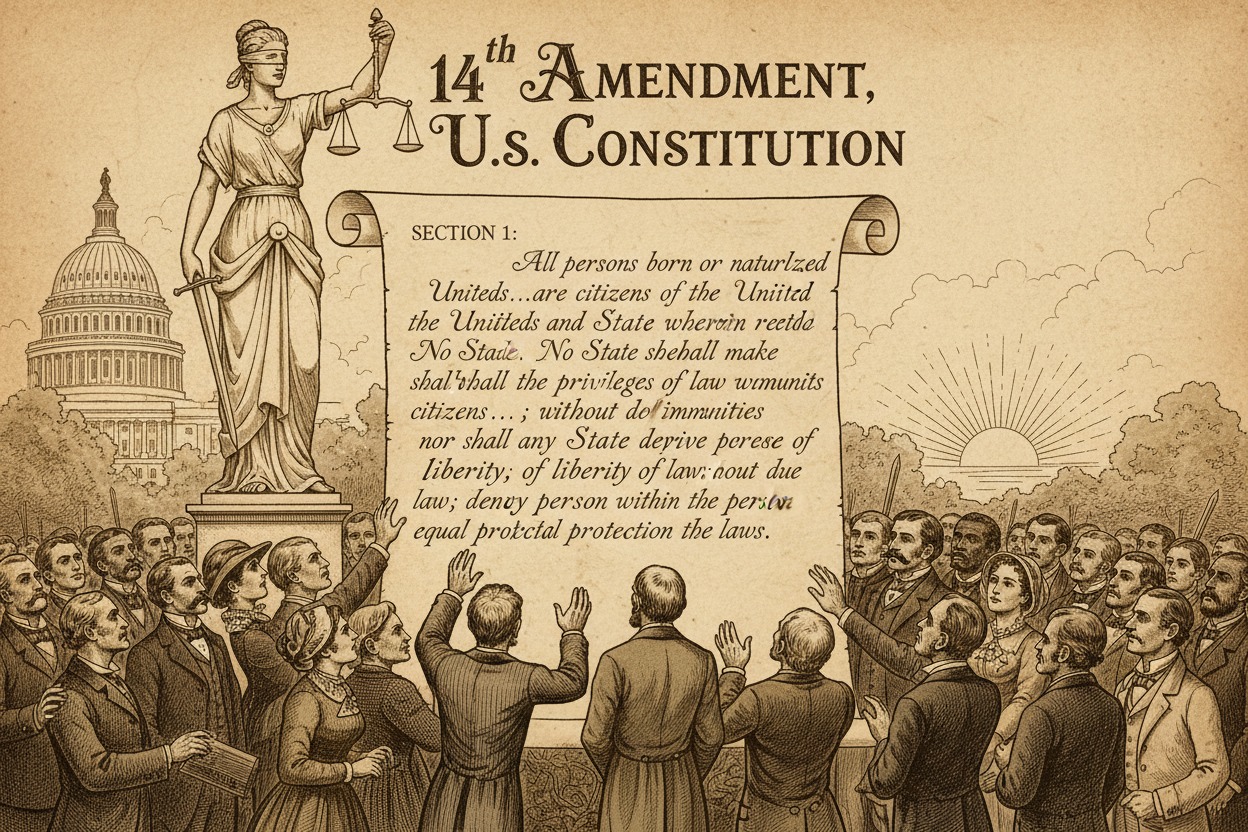
“All persons born or naturalized in the United States, and subject to the jurisdiction thereof, are citizens of the United States and of the State wherein they reside. No State shall make or enforce any law which shall abridge the privileges or immunities of citizens of the United States; nor shall any State deprive any person of life, liberty, or property, without due process of law; nor deny to any person within its jurisdiction the equal protection of the laws.”
That one paragraph does four separate jobs at once. Here’s what each part means.
The Citizenship Clause
The opening sentence establishes what’s known as birthright citizenship: anyone born on U.S. soil, and subject to its legal jurisdiction, is automatically a citizen of the United States and of the state where they live. This directly overturned the Supreme Court’s 1857 ruling in Dred Scott v. Sandford, which had held that people of African descent could never be U.S. citizens, regardless of whether they were born free.
The Privileges or Immunities Clause
This clause bars states from passing laws that undercut the fundamental rights of national citizenship. In practice, its power was significantly narrowed early on — in the 1873 Slaughter-House Cases, the Supreme Court limited this clause to a narrow set of rights, effectively shifting most modern civil rights litigation onto the Due Process and Equal Protection Clauses instead, according to LegalClarity’s analysis of the amendment’s legal history.
The Due Process Clause
This clause says states cannot take away a person’s life, liberty, or property without fair legal proceedings. It applies to “any person,” not just citizens, and it’s the constitutional foundation for a huge range of individual rights that courts have recognized over the decades.
The Equal Protection Clause
This clause requires states to apply their laws equally to all people within their jurisdiction. It’s the constitutional basis for landmark rulings like Brown v. Board of Education, which struck down school segregation, and Loving v. Virginia, which struck down bans on interracial marriage, according to a summary from FindLaw.
What Exactly Does the 14th Amendment Say? Section 2 Through Section 5
Beyond citizenship, the amendment addresses four additional areas. Here’s the full text and meaning of each remaining section.
Section 2: Apportionment of Representatives
“Representatives shall be apportioned among the several States according to their respective numbers, counting the whole number of persons in each State, excluding Indians not taxed.”
This section changed how congressional seats are calculated, requiring states to count the whole population — including formerly enslaved people, who had previously been counted as only three-fifths of a person under the original Constitution. It also penalized states that denied voting rights to eligible male citizens by reducing their congressional representation, though this specific voting-rights penalty was never actually enforced by Congress. Note that a portion of this section was later modified by the 26th Amendment, which lowered the voting age to 18.
Section 3: Disqualification for Insurrection
“No person shall be a Senator or Representative in Congress, or elector of President and Vice-President, or hold any office, civil or military, under the United States, or under any State, who, having previously taken an oath, as a member of Congress, or as an officer of the United States, or as a member of any State legislature, or as an executive or judicial officer of any State, to support the Constitution of the United States, shall have engaged in insurrection or rebellion against the same, or given aid or comfort to the enemies thereof. But Congress may by a vote of two-thirds of each House, remove such disability.”
Originally aimed at barring former Confederate officials from returning to federal or state office, this clause has drawn renewed attention in recent years as courts and legal scholars have debated its modern application. Congress retains the power to remove this disqualification with a two-thirds vote in each chamber.
Section 4: Validity of the Public Debt
“The validity of the public debt of the United States, authorized by law, including debts incurred for payment of pensions and bounties for services in suppressing insurrection or rebellion, shall not be questioned. But neither the United States nor any State shall assume or pay any debt or obligation incurred in aid of insurrection or rebellion against the United States, or any claim for the loss or emancipation of any slave; but all such debts, obligations and claims shall be held illegal and void.”
This section guaranteed that the federal government would honor debts taken on to fund the Union’s war effort, while simultaneously voiding any Confederate war debts and refusing any compensation claims for the loss of enslaved people. It’s occasionally referenced in modern political debates about the federal debt ceiling, though the Supreme Court has only briefly interpreted this specific clause, most notably in the 1935 case Perry v. United States, according to legal commentary from Cornell Law School.
Section 5: Congressional Enforcement Power
“The Congress shall have power to enforce, by appropriate legislation, the provisions of this article.”
This final section gives Congress explicit authority to pass laws enforcing every part of the amendment — a power it has used repeatedly, including for major civil rights legislation throughout the 20th century.
Quick Reference Table: The 14th Amendment, Section by Section
| Section | What It Covers | Key Impact |
|---|---|---|
| Section 1 | Citizenship, privileges/immunities, due process, equal protection | Birthright citizenship; basis for most modern civil rights law |
| Section 2 | Apportionment of congressional representatives | Ended the three-fifths compromise counting method |
| Section 3 | Disqualification from office for insurrection | Barred former Confederate officials; still debated today |
| Section 4 | Validity of public debt | Protected Union war debts; voided Confederate debts |
| Section 5 | Congressional enforcement power | Lets Congress pass laws to enforce the amendment |
Why the 14th Amendment Still Matters Today
Section 1 alone continues to shape modern law far beyond its original Reconstruction-era purpose. Courts have relied on its Due Process and Equal Protection Clauses to decide cases involving school desegregation, marriage rights, voting rights, and countless other areas where state action intersects with individual rights. It remains, by most legal measures, the single most litigated provision in the entire U.S. Constitution.
Pros and Cons of How the 14th Amendment Is Interpreted Today
| Strengths | Ongoing Debates |
|---|---|
| Established clear, universal birthright citizenship | Some debate the scope of “subject to the jurisdiction thereof” |
| Provides a broad constitutional basis for equal treatment under law | Courts continue to interpret how far Equal Protection extends to new issues |
| Gives Congress explicit enforcement power | Section 3’s modern application to insurrection remains actively litigated |
| Applies due process protections to “any person,” not just citizens | The Privileges or Immunities Clause remains narrowly interpreted since 1873 |
Expert Tips for Understanding the 14th Amendment
- Focus on Section 1 first. It’s the section that comes up in almost every real-world legal or political discussion involving the amendment.
- Separate the four clauses of Section 1. Citizenship, Privileges or Immunities, Due Process, and Equal Protection each have distinct legal histories and shouldn’t be treated as one single idea.
- Read primary sources when possible. The National Archives and Constitution Center both publish the exact ratified text, which is the most reliable starting point before reading any interpretation or commentary.
- Understand the historical context. The amendment was written specifically in response to the Civil War and the Black Codes that Southern states passed to restrict the rights of formerly enslaved people — that context shapes how courts still interpret it.
- Know that interpretation has evolved. Landmark cases like Brown v. Board of Education and Loving v. Virginia show how the same text has been applied to circumstances far beyond what its authors originally anticipated.
FAQs
1. What does the 14th Amendment say, in the simplest terms?
It guarantees that anyone born or naturalized in the United States is a citizen, and it requires states to provide due process and equal protection of the law to everyone within their jurisdiction.
2. What does the 14th Amendment say about citizenship specifically?
Section 1 states that all persons born or naturalized in the United States, and subject to its jurisdiction, are citizens of both the United States and the state where they reside — this is known as the Citizenship Clause.
3. What does the 14th Amendment say exactly, word for word?
The full text spans five sections covering citizenship and equal protection (Section 1), congressional apportionment (Section 2), disqualification for insurrection (Section 3), public debt (Section 4), and Congress’s enforcement power (Section 5) — the exact wording is available through the National Archives and the National Constitution Center.
4. When was the 14th Amendment ratified?
It was passed by Congress on June 13, 1866, and ratified on July 9, 1868, as one of the three Reconstruction Amendments following the Civil War.
5. Why is the 14th Amendment considered so important today?
Its Due Process and Equal Protection Clauses form the constitutional basis for many of the most significant civil rights rulings in American history, and it remains the most frequently litigated provision in the Constitution.
Final Thoughts
The 14th Amendment is dense, but its core message is fairly direct: citizenship belongs to everyone born or naturalized on U.S. soil, and no state can deny any person due process or equal protection under the law. That single idea, first written to address the aftermath of slavery and the Civil War, continues to shape nearly every major civil rights case that reaches the Supreme Court today.
Want to go deeper? Reading the exact text alongside a landmark case like Brown v. Board of Education or Loving v. Virginia is one of the clearest ways to see how these words have shaped real decisions that still affect American life.
This article is for general informational and educational purposes and isn’t legal advice.
Also Read: What Is a Security Classification Guide? Full Explainer
What Is a Viscount? Rank, History & Meaning Explained